People, Places, and Things
"UH OH, THE POOR CH AIR has lost its ball and doesn't want anyone to know." To me, the most interesting thing about the chair in figure 5.1 is that my reaction upon viewing "the poor chair" is perfectly sensible. Certainly I don't believe the chair is animate, that it has a brain, let alone feelings and beliefs. Yet there it is, clearly sneaking out its foot, hoping nobody will notice. What is going on?
This is an example of our tendency to read emotional responses into anything, animate or not. We are social creatures, biologically prepared to interact with others, and the nature of that interaction depends very much on our ability to understand another's mood. Facial expressions and body language are automatic, indirect results of our affective state, in part because affect is closely tied to behavior. Once the emotional system primes our muscles in preparation for action, other people can interpret our internal states by looking at how tense or relaxed we are, how our face changes, how our limbs move-
in short, our body language. Over millions of years, this ability to read others has become part of our biological heritage. As a result, we readily perceive emotional states in other people and, for that matter, anything that is at all vaguely lifelike. Hence our reaction to figure 5.1: the chair's posture is so compelling.
We have evolved to interpret even the most subtle of indicators. When we deal with people, this faculty is of huge value. It is even useful with animals. Thus, we can often interpret the affective state of animals-and they can interpret ours. This is possible because we share common origins for facial expression, gesture, and body posture. Similar interpretations of inanimate objects might seem bizarre, but the impulse comes from the same source-our automatic interpretive mechanisms. We interpret everything we experience, much of it in human terms. This is called anthropomorphism, the attribution of human motivations, beliefs, and feelings to animals and inanimate things. The more behavior something exhibits, the more we are apt to do this. We are anthropomorphic toward animals in general, especially our pets, and toward toys such as dolls, and anything we may interact with, such as computers, appliances, and automobiles. We treat tennis rackets, balls, and hand tools as animate beings, verbally praising them when they do a good job for us, blaming them when they refuse to perform as we had wished.
Byron Reeves and Clifford Nass have done numerous experiments that demonstrate-as the subtitle of their book puts it-"how people treat computers, television, and new media like real people ·and places." B. J. Fogg shows how people think of "computers as social actors," in his chapter of that title in his Persuasive Technology. Fogg proposes five primary social cues that people use to infer sociability with the person, or device, with whom, or which, they are interacting:
Physical: Face, eyes, body, movement
Psychological: Preferences, humor, personality, feelings, empathy, "I'm sorry"
Language: Interactive language use, spoken language, language recognition
Social Dynamics: Turn taking, cooperation, praise for good work, answering questions, reciprocity
Social Roles: Doctor, teammate, opponent, teacher, pet, guide
With the chair in figure 5.1, we succumb to the physical side. With computers, we often fall for the social dynamics (or, as is more often the case, the inept social dynamics). Basically, if something interacts with us, we interpret that interaction; the more responsive it is to us through its body actions, its language, its taking of turns, and itsgeneral responsiveness, the more we treat it like a social actor. This list applies to everything, human or animal, animate or non-animate.
Note that just as we infer the mental intentions of a chair without any real basis, we do the same for animals and other people. We don't have any more access to another person's mind than we do to the mind of an animal or chair. Our judgments of others are private interpretations based on observation and inference, not much different, really, than the evidence that makes us feel sorry for the poor chair. In fact, we don't have all that much information about the workings of our own minds. Only the reflective level is conscious: most of our motivations, beliefs, and feelings operate at the visceral and behavioral levels, below the level of awareness. The reflective level tries hard to make sense of the actions and behavior of the subconscious. But in fact, most of our behavior is subconscious and unknowable. Hence the need for others to aid us in times of trouble, for psychiatrists, psychologists, and analysts. Hence Sigmund Freud's historically impressive descriptions of the workings of id, ego, and superego.
So interpret we do, and over the many thousands or millions of years of evolution, we have coevolved muscle systems that display our emotions, and perceptual systems that interpret those of others. And with that interpretation also comes emotional judgment and empathy. We interpret, we emote. We can thereby believe that the object of our interpretations is sad or happy, angry or calm, sneaky or
embarrassed. And, in turn, we ourselves can become emotional just by our interpretation of others. We cannot control those initial interpretations, for they come automatically, built in at the visceral level. We can control the final emotions through reflective analysis, but those initial impressions are subconscious and automatic. But, more important, it is this behavior that greases the wheels of social interaction, that makes it possible.
Designers take note. Humans are predisposed to anthropomorphize, to project human emotions and beliefs into anything. On the one hand, the anthropomorphic responses can bring great delight and pleasure to the user of a product. If everything works smoothly, fulfilling expectations, the affective system responds positively, bringing pleasure to the user. Similarly, if the design itself is elegant, beautiful, or perhaps playful and fun, once again the affective system reacts positively. In both cases, we attribute our pleasure to the product, so we praise it, and in extreme cases become emotionally attached to it. But when the behavior is frustrating, when the system appears to be recalcitrant, refusing to behave properly, the result is negative affect, anger, or worse, even rage. We blame the product. The principles for designing pleasurable, effective interaction between people and products are the very same ones that support pleasurable and effective interaction between individuals.
Blaming Inanimate Objects
It starts out with slight annoyance, then the hairs on your neck start to prickle and your hands begin to sweat. Soon you are banging your computer or yelling at the screen, and you might well end up belting the person sitting next to you.
-Newspaper article on "Computer Rage"
Many of us have experienced the computer rage described in the epigraph. Computers can indeed be infuriating. But why? And why do
we get so angry at inanimate objects? The computer-or for that matter, any machine-doesn't intend to anger; machines have no intentions at all, at least not yet. We get angry because that's how our mind works. As far as we are concerned, we have done everything right, so the inappropriate behavior is therefore the fault of the computer. The "we" who faults the computer comes from the reflective level of our minds, the level that observes and passes judgment. Negative judgments lead to negative emotions, which can then inflame the judgments. The system for making judgments-cognition-is tightly coupled with the emotional system: each reinforces the other. The longer a problems lasts, the worse it becomes. Mild unhappiness is transformed into strong unhappiness. Unhappiness is transformed into anger, and anger into rage.
Note that when we get angry at our computer, we are assigning blame. Blame and its opposite, credit, are social judgments, assigning responsibility. This requires a more complex affective assessment than the dissatisfaction or pleasure one gets from a well- or ill-designed product. Blame or credit can come about only if we are treating the machine as if it were a causal agent, as if it made choices, in other words, as a human does.
How does this happen? Neither the visceral nor the behavioral level can determine causes. It is the role of reflection to understand, to interpret and find reasons, and to assign causes. Most of our rich, deepest emotions are ones where we have attributed a cause to an occurrence. These emotions originate from reflection. For example, two of the simpler emotions are hope and anxiety, hope resulting from expectation of a positive result, anxiety from expectation of something negative. If you are anxious, but the expected negative outcome doesn't happen, your emotion is one of relief. If you expect something positive, you are hopeful, and if it doesn't happen, then you feel disappointment.
So far, this is pretty simple, but suppose you-at your reflective level, to be more precise-decide that the result was someone's fault? Now we get into the complex emotions. Whose fault was it? When the
result is negative and the blame put on yourself, you get remorse, selfanger, and shame. If you blame someone else, then you feel anger and reproach.
When the result is positive and the credit yours, you get pride and gratification. When the credit is someone else's, you get gratitude and admiration. Note how emotions reflect the interaction with others. Affect and emotion constitute a complex subject, involving all three levels, with the most complex emotions dependent upon just how the reflective level attributes causes. Reflection, therefore, is at the heart of the cognitive basis of emotions. The important point is that these emotions apply equally well to things as to people, and why not? Why distinguish between animate and inanimate things? You build up expectations of behavior based upon prior experience, and if the items with which you interact fail to live up to expectations, that is a violation of trust, for which you assign blame, which can soon lead to anger.
Cooperation relies on trust. For a team to work effectively each individual needs to be able to count on team members to behave as expected. Establishing trust is complex, but it involves, among other things, implicit and explicit promises, then clear attempts to deliver, and, moreover, evidence. When someone fails to deliver as expected, whether or not trust is violated depends upon the situation and'upon where the blame falls.
Simple mechanical objects can be trusted, if only because their behavior is so simple that our expectations are apt to be accurate. Yes, a support or a knife blade may break unexpectedly, but that is about the largest possible transgression a simple object can do. Complex mechanical devices can go wrong in many more ways, and many a person has fallen in love-or become outraged-over the transgressions of automobiles, shop equipment, or other complex machinery.
When it comes to a lack of trust, the worst offenders of all are today's electronic devices, especially the computer (although the cell phone is rapidly gaining ground). The problem here is that you don't know what to expect. The manufacturerspromise all sorts of wonder-
ful results; but, in fact, the technology and its operations are invisible, mysteriously hidden from view, and often completely arbitrary, secretive, and sometimes even contradictory. Without any way of understanding how they operate or what actions they are doing, you can feel out of control and frequently disappointed. Trust eventually gives way to rage.
I believe that those of us who become angry with today's technology are justified. It may be an automatic result of our affective and emotional systems. It may not be rational, but so what? It is appropriate. Is it the computer's fault, or is it the software that runs within it? Is it really the software's fault, or is it the programmers who neglected to understand our real needs? As users of the technology, we don't care. All we care about is that our lives are made more frustrating. It is "their fault," "their" being everyone and everything involved in the computer's development. After all, these systems do not do a very good job of gathering trust. They lose files and they crash, oftentimes for no apparent reason. Moreover, they express no shame, no blame. They don't apologize or say they are sorry. Worse, they appear to blame us, the poor unwitting users. Who is "they"? Why does it matter? We are angered, and appropriately so.
Trust and Design
My 10-inch Wusthof chef knife. I could go on about the feel and aesthetic beauty, but upon further introspection I think my emotional attachment is substantially based on trust that comes from experience.
I know that my knife is up to whatever task I use it for. It is not going to slip out of my hand, the blade it not going to snap or break no matter how much pressure I apply; it is sharp enough to cut bones; it is not going to mutilate the meal I am about to serve to guests. I hate cooking in other people's kitchens and using their cutlery, even if it is good quality stuff.
This is a durable good, meaning I will only need to buy chef knives
once or twice in a lifetime. I liked it OK when I purchased it, but my emotional attachment to it has developed over time through literally hundreds of consecutive positive experiences. This object is my friend.
The response above, one of many I received offering examples of products that people have learned to love or hate, vividly demonstrates the importance and power and properties of trust. Trust implies several qualities: reliance, confidence, and integrity. It means that one can count on a trusted system to perform precisely according to expectation. It implies integrity and, in a person, character. In artificial devices, trust means having it perform reliably, time after time after time. But there is more. In particular, we have high expectations of systems we trust: we expect them "to perform precisely according to expectation," which; of course, implies that we have built up particular expectations. These expectations come from multiple sources: the advertisements and recommendations that led us to buy the item in the first place; the reliability with which it has been performing since we got it; and, perhaps most important of all, the conceptual model we have of the item.
Your conceptual model of a product or service-and the feedback that you receive-is essential in establishing and maintaining trust. As I discussed in chapter 3, a conceptual model is your understanding of what an item is and how it works. If you have a good, accurate conceptual model, especially if the item keeps you informed about what it is doing-what stage in the operations it has reached, and whether things are proceeding smoothly or not-then you are not surprised by the result.
Consider what happens when your car runs out of gasoline. Whose fault is it? It depends. Most people's conceptual model of a car includes a fuel gauge that says what percentage of the tank is filled with gasoline. Many people also expect a warning such as a flashing light when the tank is close to empty. Some people even rely upon their assumption that the gas gauge is conservative, indicating that the tank is emptier than it really is, giving some leeway.
Suppose that the gas gauge has been reading close to empty, the warning light has flashed, but you procrastinate, not wanting to take the time to refill. If you run out of gasoline, you will blame yourself. Not only will you not be upset at the car, you might even now trust it more than ever. After all, it indicated you were going to run out of fuel, and you did. What if the warning light never came on? In that case you would blame the car. What if the gas gauge fluctuated up and down, continually varying? Then you wouldn't know how to interpret it: you wouldn't trust it.
Do you trust the gas gauge of your car? Most people are wary at first. When they drive in a new car, they have to do some tests to discover how much to trust the gas gauge. The typical way is to drive the car to lower and lower fuel estimates before refilling. The true test, of course, would be to run out of fuel deliberately in order to see how that corresponded to the meter reading, but most people don't need that much reassurance. Rather, they do enough driving to determine how much to trust the indicator, whether it be the meter reading or the lowfuel warning light in some cars, or for those with trip computers, the miles of driving the computer predicts can be done with the remaining fuel. With sufficient experience, people learn how to interpret the readings and, thus, how much to trust the gauge. Trust has to be earned.
Living in an Untrustworthy World
It's human nature to trust our fellow man, especially when the request meets the test of being reasonable. Social engineers use this knowledge to exploit their victims and to achieve their goals.
-K. D. Mitnick and W. L. Simon,
The Art of Deception
Trust is an essential ingredient in cooperative, human interaction. Alas, this also makes it a vulnerability, ready for exploitation by what is called
"social engineering," the crooks, thieves, and terrorists who exploit and manipulate our trust and good nature for their gain. As more and more of our everyday objects are manufactured with computer chips inside, with intelligence and flexibility, and with communication channels to the other devices in our environment and to the worldwide network of information and services, it is critical to worry about those who would do harm, whether by accident, for the sake of mischief, for fun, or with malicious intent to defraud or harm. Crooks, thieves, criminals, and terrorists are experts at exploiting the willingness of people to help one another, both to figure out how to use onerous technology and when someone appears to be in urgent need of assistance.
A common approach to improved safety and security is to tighten up on procedures and to require redundant checking. But as more people are involved in checking a task, safety can decrease. This is called "bystander apathy," a term that came from studies of the 1964 murder of Kitty Genovese on the streets of New York City. Although numerous people witnessed that incident, no one helped. At first the lack of response was simply blamed on the callousness of New York City residents, but social psychologists Bibb Latane and John Darley were able to repeat the bystander behavior, both in their laboratory and in field studies. They concluded that the more people watching, the less likely anyone would help. Why?
Think about your own reaction. If you were by yourself, walking along the streets of a large city and encountered what looked like a crime, you might be frightened and, therefore, reluctant to intervene. Still, you probably would try to call for help. But suppose a crowd of people were watching the incident? What would you do then? You probably would assume that you weren't witnessing anything serious, because if it were, people in the crowd would be doing something. The fact that nobody is doing anything must mean that nothing bad is happening. After all, in a large city, anything might happen: maybe it's actors making a movie.
Bystander apathy works in security as well. Suppose that you are working as a technician at a power plant. Among your jobs, you are
supposed to check the meter readings with one of your colleagues, another technician at the plant, a person you know and trust. Moreover, when you have finished, your supervisor will also do a check. The result is that you don't have to exert extra care on the task. After all, how could a mistake get through with so many people? The problem is that everyone feels this way. As a result, the more people that check on something, the less carefully each person performs the task. As more people are responsible, security may diminish: trust gets in the way.
The commercial aviation community has done an excellent job of fighting this tendency with its program of "Crew Resource Management." All modern commercial aircraft have two pilots. One, the more senior, is the captain, who sits in the left-hand seat, while the other is the first-officer, who sits in the right-hand seat. Both are qualified pilots, however, and it is common for them to take turns piloting the aircraft. As a result, they are referred to by the terms "pilot flying" and "pilot not flying." A major component of crew resource management is that the pilot who is not flying be an active critic, continually checking and questioning the actions taken by the pilot who is flying. The pilot flying is supposed to thank the other for the questions, even when they are unnecessary, or even wrong. Obviously, getting this process in place was difficult, for it involved major changes in the culture, especially when one pilot was junior. After all, when one person questions another's behavior, it implies a lack of trust; and when two people are supposed to work together, especially when one is superior to the other, trust is essential. It took a while before the aviation community learned to take the questioning as a mark of respect, rather than a lack of trust, and for senior pilots to insist that junior ones question all of their actions. The result has been increased safety.
Criminals and terrorists take advantage of misplaced trust. One strategy to break into a well-guarded place is to trigger the alarms repeatedly over the course of a few days, and then hide so that the security personnel cannot find any cause for the trigger. Eventually, in
frustration over the repeated false alarms, the security people will no longer trust them. It is then the criminals break in.
Not everyone is untrustworthy, just a few-but those few can be so severely disruptive that we have little choice but to relinquish trust and be suspicious of everyone, everything. There is a terrible tradeoff here: the very things that make security tighter are often those that make our lives more difficult or, in some cases, impossible. We need more realistic security that is cognizant of human behavior.
Security is more of a social or human problem than a technological one. Sure, put in all the technology you like. Those who wish to steal, corrupt, or disrupt will find a way to take advantage of human nature and bypass the security. Indeed, excessive technology gets in the way of security, because, by making the task of conscientious, everyday workers more difficult, it makes the job of bypassing the security measures even easier. When the security codes or procedures become too complex, people can't remember them, so they will write them down and post them on their computer terminals, under their keyboards or phones, or in their desk drawer (on top, though, where they are easy to get to).
As I was writing this book, I served on a committee of the United States National Research Council investigating information technology and counterterrorism. For my section of the report, I studied the social engineering practices used by terrorists, criminals, and other troublemakers. Actually, it's not difficult to find this information. The basic principles have been around for centuries and there are many books by ex-criminals, law-enforcement officers, and even guides to writing crime novels that provide relevant information. The internet makes the research easy.
Want to break into a secure facility? Walk up to the door carrying an armload of computers, parts, and dangling cords. Ask someone to hold open the door, and thank them. Carry the junk over to an empty cubicle, look for the password and login name, which will be posted somewhere, and log in (figure 5.2). If you can't log in, ask someone for help. Just ask.As one handbook that I found on the internet puts
Figure a shows a note posted on the side of the computer display; figure b is an enlargement of the note. This is the sort of behavior that social engineers count on. But it is bad password policies that make us have to resort to this. Even if the password wasn't attached to the computer, a good social engineer could have guessed it: this computer is at the corporate headquarters of a major manufacturer of office furniture. "Chair"? Who WOUld ever guess? (Photograph by author.)
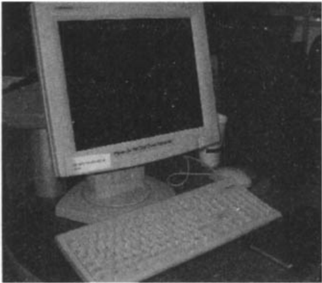
FIGURE 5.2a and b
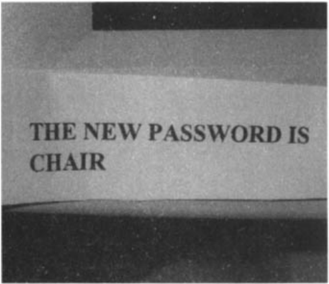
How not to safeguard a password.
it: Just shout, "Does anyone remember the password for this terminal?" You would be surprised how many people will tell you.
In the end, security is a systems problem, where the human is the most important component. When security procedures get in the way of well-meaning, dedicated workers, they will find work-arounds to avoid disruption, thus defeating the whole point of the procedure. The very attributes that make us effective, cooperative, creative workers, able to adapt to the unexpected and to provide assistance to others, make us vulnerable to those who would take advantage of us.
Communications That Serve Emotion
Everywhere is nowhere. When a person spends all his time in foreign travel, he ends by having many acquaintances, but no friends.
-Lucius Annaeus Seneca (5 BC-AD 65)
In my consulting work, I am often called upon to predict the next "killer application," to discover the next product that will be so popular that everyone will have to own it. Unfortunately, if I have learned anything, it is that precise predictions of this sort are simply not possible. The field is littered with the bodies of those who have tried. Moreover, it is possible to be correct about a prediction, but very far off as to its time frame. I predict that automobiles will drive themselves. When? I have no idea: it might be twenty years, it might be one hundred. I predict that video telephones will become so popular that they will be everywhere, and we will simply take them for granted. In fact, people might complain if there weren't any video. When? Forecasters have been predicting widespread adoption of video phones "in just a few years" for the last fifty years. Even successful products can take decades before they catch on.
But even if exact prediction of successful products is not possible, we can be certain of one category that almost always guarantees success: social interaction. Throughout the last one hundred years, as technologies have changed, the importance of communication has remained high on the list of essentials. For individual communication, this has meant mail, the telephone, email, cell phones, and instant messaging and text messaging on computers and cell phones. For organizations, add the telegraph, the corporate memo and newsletter, the fax machine, and the intranet, that specialization of the internet for intracompany communication and interaction. And for societal groups, add the town crier, the daily newspaper, radio, and television.
Up to a few years ago,the increasing ease and lowered cost of travel had the unfortunate side effect of weakening the bonds that hold people together. Yes, through letters and telephone people could still be somewhat in touch, but this touch was limited. Two thousand years ago the Roman philosopher Seneca complained that travel led to many acquaintances but few friends, and up to recently this complaint still held true. Distance used to matter. Move away from family and friends, and the contact waned. Sure, one could use mail and telephone, but these were sparse communications amidst the busy activities of the day. People who separated physically would often separate socially and emotionally as well.
No more: today we can be in continual contact with friends and relatives no matter where we are, no matter the time of day. Today's technology makes it possible to stay in touch with friends and family on a continual basis. Email, instant messaging, text messages, and voice mail have no barriers in time or distance. Travel is relatively easy by auto, train, or airplane. The mail system reliably traverses the earth. The telephone is readily available and, with the cellular phone, always with us, always on. Email is ubiquitous. Billions of short messages are sent daily among the cell phones of the world. The isolation once imposed by distance and separation is no longer true. Today we can easily keep in touch with one another to an amount undreamed of earlier. Moreover, the communication revolution has barely begun: if it is so pervasive now, at the start of the twenty-first century, what will it be in one hundred years?
Most of the short text messages appear to be content-free. Among teenagers, they are apt to say: "What are you doing?"-or, in the highly abbreviated form they often take, "watrudoin"; "Where are you? (wru)"; "Seeyou later (culSr)." Among business people during the business day, they differ slightly: "Boring meeting"; "What are you doing?"; "Want a drink after work?" Occasionally, of course, they have real substance, as in business negotiations or in arranging meeting times or the details of a contract. But, on the whole, the point
of the frequent messages is not information sharing; it is emotional connecting. They are ways of saying to one another, "I'mhere,""you are there," "we still like each other." People need to communicate continually, for comfort, for reassurance.
The real advantage of text messaging is that it can be used while you are doing other things. As long as your hands are free and you can sneak an occasional look at the screen, you can send and receive messages: in class, at business meetings, or even while conversing with others. There seem to be no bounds. Stick the device in your shirt pocket. Then, when bored, or when that pleasant vibrating sensation on the chest signifies the arrival of a new message, take it out and peek. Read the latest words and surreptitiously type a reply, using two thumbs on the tiny keyboard. Surreptitiously, because this is probably taking place at a meeting, where you are supposed to be attending to the speaker.
The ability to use short text messages so effortlessly has become a strong, emotional component of many people's lives. Numerous people who responded to my Internet request for experiences of bonding used the opportunity to tell me about their attachment to Instant Messaging (IM). Here are two responses:
Instant messenger (IM) is an integrated part of my life. With it I have a sense of connection to many of my friends and colleagues around the world. Without it, I feel as though a window to part of my world is bolted shut.
Another example is IM. I am so attached to my IM at work. I can't imagine my life without it. The real power of IM isn't the message (though that is a key attribute), but it's the presence detection. Knowing that someone "is there." Imagine knowing that every time you pick up the phone to dial someone there is going to be a realperson to answer, and the person you want. That is the power of instant messaging.
The cell phone shares much of the emotional power of text messaging. It is much more than a simple communication device. Oh,
sure, business thinks of it as a way of keeping in touch, of getting critical information to people when they need it, but that misses the whole point of these devices. It is fundamentally an emotional tool and a social facilitator. It keeps people in touch with one another. It lets friends chat: even if the formal, reflective content is vague, the emotional content is high. But although it lets us all share thoughts and ideas, music, and pictures, what it really lets us share is emotion. The ability to keep in touch throughout the day maintains a relationship, whether it be business or social.
Speech is a powerful social and emotional vehicle because it enables communication of emotional state through its natural prosodypauses, rhythm, pitch inflections, hesitations, and repeats. Although text messaging is not as effective as speech at communicating emotion, it is superior as a tool for communication because it is unobtrusive. It can be kept private and it can be done secretly. I am always amused at business meetings by the sneaky, but skillful, use of text messaging. I watch otherwise serious, staid executives glance furtively down at their laps so as to read screens and type responses, all the while pretending to be listening to the meeting. Text messaging lets friends keep in touch, even when they should be attending to something else.
Isn't it strange that, although telephone service is an emotional tool, the appliance itself is not? People love the power of cell phone interaction, but do not seem to love any of the devices that make it possible. As a result, the turnover of devices is high. There is no product loyalty, no commitment to company or service provider. The cell phone, one of the most fundamentally emotional services, garners little attachment to its products.
Vernor Vinge, one of my favorite science fiction writers, wrote A Fire Upon the Deep, in which the planet Tines is populated by animals with a collective intelligence. These doglike creatures travel in packs, whose members are in continuous acoustical communication with one another, giving rise to a powerful, distributed consciousness. Individuals leave the pack because of death, illness, or accident, and new, young members are recruited to replace them, so that the pack
maintains its identity far beyond that of any single individual. Each individual member of a pack lacks intelligence when all alone: the pack gains its intelligence through the collaboration of the many individuals. As a result, if an individual strays too far from the pack, the communication path is lost-for sound has limited range-and the resulting "singleton" is devoid of intelligence. Singletons rarely survive, and those that do are doomed to a mindless existence-literally mindless.
Walk down the street of any large city in any country of the world and watch the people who are talking on their cell phones: they are in their own space, physically adjacent to one location and one set of people but emotionally somewhere else. It is as if they fear beingsingletons in the crowd of strangers and opt instead to maintain connection with their pack, even if the pack is elsewhere. The cell phone establishes its own private space, removed from the street. Were the two people together, walking down the street, they would not be so isolated, for they would both be aware of one another, of the conversation and of the street. But with the cell phone, you enter into a private place that is virtual, not real, one removed from the surrounds, the better to bond with the other person and the conversation. And so you are lost to the street even while walking along it. Truly a private space in a public place.
Always Connected, Always Distracted
I H AV E watched phones ring and be answered in the most amazing places. In the movie theater, in the middle of board meetings. I once attended a meeting at the Vatican where I was part of a scientific delegation presenting our findings to the Pope. Cell phones were everywhere: each cardinal wore a gold chain upon which was hung a gold cross, each bishop had a gold chain upon which was hung a silver cross, but the head usher, who seemed to be the real person in charge, wore a gold chain upon which was hung a cell phone. The Pope may have been the center of attention, but I heard cell phones ringing con-
tinually throughout the ceremony. "Scusi," they would whisper into their phones, "I can't talk right now, I'm listening to the Pope."
On another occasion I was a member of a discussion panel in front of a large audience, when the moderator's cell phone rang just as he was in the middle of asking a question of one of the panelists. Yes, he answered it, disconcerting the panel members, but amusing the audience.
HURRAH FOR the communication technologies that allow us continuous contact with our colleagues, friends, and families, no matter where we are, no matter what we are doing! But, however powerful text and voice messages, phone calls, and emails are as tools for maintaining relationships or supervising work, note that one person's "keeping in touch" is another person's interruption. The emotional impact reflects this discrepancy: positive to the person keeping in touch, but negative and disturbing to the person being subjected to interruption.
There is a lack of symmetry in the perceived impact of an interruption. When I have lunch with friends who spend a considerable fraction of our time responding to calls on their cell phones, I consider this a distraction and an interruption. From their point of view, they are still with me, but the calls are essential to their lives and emotions and not at all an interruption. To the person taking the call, the time is filled, with information being conveyed. To me, it is empty unfilled time. The lunchtime conversation is now on hold. I have to wait for the interruption to end.
How much time does the interruption seem to take? To the person being interrupted, forever. To the person taking the call, just a few seconds. Perception is everything. When one is busy, times flies quickly. When there is nothing to do, it seems to drag. As a result, the person engaged in the cell phone conversation feels emotionally satisfied, while the other feels ignored and distanced, emotionally upset.
Human conscious attention is a component of the reflective level of the mind. It has limited capability. On the one hand, it limits the focus
of consciousness, primarily to a single task. On the other hand, attention is readily distracted by changes in the environment. The result of this natural distractibility is a short attention span: new events continually engage attention. Today it is customary to argue that short attention spans are caused by advertisements, video games, music videos, and so on. But, in fact, the ready distractibility of attention is a biological necessity, developed through millions of years of evolution as a protective mechanism against unexpected danger: this is the primary function of the visceral level. This is probably why one byproduct of the negative affect and anxiety that results from perceived danger is a narrowing and focusing of attention. In danger, attention must not become distracted. But in the absence of anxiety, people are easily distracted, continually shifting attention. William James, the famous philosopher/psychologist, once said that his attention span was approximately ten seconds, and this in the late 1800s, far before the advent of modern distractions.
We carve out our own private spaces where needed. At home in our private study or bedroom, door locked if need be. At the office, in a private room or, struggling to accomplish privacy, in cubicles or shared space. In the library, helped by the no-talking rules andconvention, or by private carrels for the privileged few. In streets, where people will gather to form clusters of conversations, seemingly oblivious to those around them, if only temporarily.
But the real problems of modern communication come from the limitations of human attention.
The limits on conscious attention are severe. When you are on a telephone call, you are doing a very special sort of activity, for you are a part of two different spaces, one where you are located physically, the other a mental space, the private location within your mind where you interact with the person on the other end of the conversation. This mental partitioning of space is a very special facility and it makes the telephone conversation, unlike other joint activities, demand a special kind of mental concentration. The result is that you are partially away from the real, physical space, even as you inhabit it. This divi-
sion into multiple spaces has important consequences for the human ability to function.
Do you talk on a cell phone while driving an automobile? If so, you are dividing your conscious attention in a dangerous fashion, reducing your capacity to plan and anticipate. Yes, your visceral and behavioral levels of processing still function well, but not the reflective, the home of planning and anticipating. So driving is still possible, but primarily through the automatic, subconscious visceral and behavioral mechanisms. The part of driving that suffers is the reflective oversight, the planning, the ability to anticipate the actions of other drivers and any special conditions of the environment. That you can still appear to drive normally blinds you to the fact that the driving is less skillful, less able to cope with unexpected situations. Thus, the driving becomes dangerous, the cause being that distracting mental space. The danger does not stem from any requirement to hold the cell phone to your ear with one hand while steering with the other: a hands-free cell phone, where speaker and microphone are fixed to the car so that no hands are required, does not eliminate the distracting mental space. This is a new area of research, but the early studies seem to show that hands-free phones are just as dangerous as hand-held ones. The decrease in driver performance results from the conversation, not the telephone instrument.
Drive a car and hold a conversation with the passengers and, yes, some of the same distraction is present, especially because our social nature means that we tend to look at the person with whom we are conversing. Once again, the safety research is still at an early stage, but I predict that a conversation with real passengers will prove to be not as dangerous as one with far-away people, for the mental space we create for real passengers includes the auto and its surround, whereas the other one distances us from the auto. After all, we evolved to interact with others in the midst of other activities, but the evolutionary process could not anticipate communication at a distance.
We cannot take part in two intense conversations at the same time, at least not without degrading the quality and speed of each. Of
course, we can and do take part in multiple instant- and text-messaging conversations "simultaneously," but the quote marks around "simultaneously" reflect that we don't really do the operations at the same instant, but rather interweave the two. Conscious, reflective attention is only necessary for reading and for formulation of new messages, but once formulated, the automatic behavioral level mechanisms can guide the actual keystrokes while reflection switches over to the other conversation.
Because most activities do not require continual, full-time conscious attention, we are able to go about our daily activities continually dividing attention among multiple diversions. The virtue of this division of attention is that we keep in touch with the environment: we are continually aware of the things around us. Walking down the street chatting with a friend, we still have considerable resources left for a multitude of activities: to notice the new stores that have opened on the block; to glance at the newspaper headlines; even to eavesdrop upon neighboring conversations. The difficulties arise only when we are forced to engage in mechanical activities, such as driving an automobile, where the technological demands can require immediate response. Here is where the apparent ease with which we can often do these tasks misleads us into thinking that full attention is never required. Our ability to handle distractions and to divide attention is essential to social interaction. Our ability to time-share, to do multiple activities, enhances these interactions. We are aware of others around us. We keep in touch with a large number of people. The continual switching of attention is normally a virtue, especially in the world of social interaction. In the mechanical world, it can be a peril.
By continually being in communication with friends across a lifetime, across the world, we risk the paradox of enhancing shallow interactions at the expense of deep ones. Yes, we can hold continual, short interactions with numerous people, thus keeping friendships alive. But the more we hold short, brief, fleeting interactions and allow ourselves to interrupt ongoing conversations and interactions, the less we allow any depth of interaction, any depth to a relationship.
"Continuously divided attention" is the way Linda Stone has described this phenomenon, but no matter how we may deplore it, it has become a commonplace aspect of everyday life.
The Role of Design
Technology often forces us into situations where we can't live without the technology even though we may actively dislike its impact. Or we may love what the technology provides us while hating the frustrations encountered while trying to use it. Love and hate: two conflicting emotions, but commonly combined to form an enduring, if uncomfortable, relationship. These love-hate relationships can be amazingly stable.
Love-hate relationships offer promise, if only the hate can be dissipated, retaining the love. The designer has some power here, but only to a limited extent, for although some of the irritation and dislike is a result of inappropriate or impoverished design, much is a result of societal norms and standards, and these can only be changed by society itself.
Much of modern technology is really the technology of social interaction: it is the technology of trust and emotional bonds. But neither social interaction nor trust were designed into the technology or even thought through: they came about through happenstance, through the accidental byproducts of deployment. To the technologist, the technology provides a means of communication; for us, however, it provides a means for social interaction.
There is much that can be done to enhance these technologies. We have already seen that lack of trust comes about from lack of understanding, from situations where we feel out of control, unaware of what has happened, or why, or what we should do the next time. And we have seen how the unscrupulous, the thief and the terrorist can take advantage of the normal trust people have for one another, a trust that is essential if normal civilization is to exist.
In the case of the personal computer, the frustrations and irritations that lead to "computer rage" are indeed the domain of design. These are caused by design flaws that exacerbate the problems. Some have to do with the lack of reliability and bad programming, some with the lack of understanding of human needs, and some the lack of fit between the operation of the computer and the tasks that people wish to do. All these can be solved. Today, communication seems always to be with us, whether we wish it to or not. Whether at work or play, school or home, we can make contact with others. Moreover, the distinctions among the various media are disappearing, as we send voice and text, words and images, music and video back and forth with increasing ease and frequency. When my friend in Japan uses his cell phone to take a photograph of his new grandchild and sends it to me in the United States, is this email, photography, or telephony?
The good news is that the new technologies enable us always to feel connected, to be able to share our thoughts and feelings no matter where we are, no matter what we are doing, independent of the time or time zone. The bad news is, of course, those very same things. If all my friends were always to keep in touch, there would be no time for anything else. Life would be filled with interruptions, twenty-four hours a day. Each interaction alone would be pleasant and rewarding, but the total impact would be overwhelming.
The problem, however, is that the ease of short, brief communication with friends around the world disrupts the normal, everyday social interaction. Here, the only hope is for a change in social acceptance. This can go in two directions. We could all come to accept the interruptions as a part of life, thinking nothing of it when the several members of a group continually enter their own private space to interact with others-friends, bosses, coworkers, family, or perhaps their video game, where their characters are in desperate need of help. The other direction is for people to learn to limit their interactions, to let the telephone take messages by text, video or voice, so that the calls can be returned at a convenient time. I can imagine solutions designed to help facilitate this, so that the technology within a telephone might negoti-
ate with a caller, checking the calendars of each party and setting up a time to converse, all without bothering any of the individuals.
We need technologies that provide the rich power of interaction without the disruption: we need to regain control over our lives. Control, in fact, seems to be the common theme, whether it be to avoid the frustration, alienation, and anger we feel toward today's technologies, or to permit us to interact with others reliably, or to keep tight the bonds between us and our family, friends, and colleagues.
Not every interaction has to be done in real time, with participants interrupting one another, always available, always responding. The store-and-forward technologies-for example email and voice mailallow messages to be sent at the sender's convenience, but then listened to or viewed at the receiver's convenience. We need ways of intermixing the separate communication methods, so that we could choose mail, email, telephone, voice, or text as the occasion demands. People need also to set aside time when they can concentrate without interruption, so that they can stay focused.
Most of us already do this. We turn off our cell phones and deliberately do not carry them at times. We screen our telephone calls, not answering unless we see-or hear-that it is from someone we really wish to speak to. We go away to private locations, the better to write, think, or simply relax.
Today, the technologies are struggling to ensure their ubiquitous presence, so that no matter where we are, no matter what we are doing, they are available. That is fine, as long as the choice of whether to use them remains with the individual at the receiving end. I have great faith in society. I believe we will come to a sensible accommodation with these technologies. In the early years of any technology, the potential applications are matched by the all-too-apparent drawbacks, yielding the love-hate relationship so common with new technologies. Love for the potential, hate for the actuality. But with time, with improved design of both the technology and the manner in which it is used, it is possible to minimize the hate and transform the relationship to one of love.