The Multiple Faces of Emotion and Design
AFTER DI N N E R , WITH A GREAT FLOURISH, my friend Andrew brought out a lovely leather box. "Open it," he said, proudly, "and tell me what you think."
I opened the box. Inside was a gleaming stainless-steel set of old mechanical drawing instruments: dividers, compasses, extension arms for the compasses, an assortment of points, lead holders, and pens that could be fitted onto the dividers and compasses. All that was missing was the T square, the triangles, and the table. And the ink, the black India ink.
"Lovely," I said. "Those were the good old days, when we drew by hand, not by computer."
Our eyes misted as we fondled the metal pieces.
"But you know," I went on, "I hated it. My tools always slipped, the point moved before I could finish the circle, and the India ink-ugh, the India ink-it always blotted before I could finish a diagram. Ruined it! I used to curse and scream at it. I once spilled the whole bot-
tie all over the drawing, my books, and the table. India ink doesn't wash off. I hated it. Hated it!"
"Yeah," said Andrew, laughing, "you're right. I forgot how much I hated it. Worst of all was too much ink on the nibs! But the instruments are nice, aren't they?"
"Very nice," I said, "as long as we don't have to use them."
THIS STORY shows the several levels of the cognitive and emotional system-visceral, behavioral, and reflective-at work, fighting among themselves. First, the most basic visceral level responds with pleasure to seeing the well-designed leather case and gleaming stainlesssteel instruments and to feeling their comfortable heft. That visceral response is immediate and positive, triggering the reflective system to think back about the past, many decades ago, "the good old days," when my friend and I actually used those tools. But the more we reflect upon the past, the more we remember the actual negative experiences, and herein lies the conflict with the initial visceral reaction.
We recall how badly we actually performed, how the tools were never completely under control, sometimes causing us to lose hours of work. Now, in each of us, visceral is pitted against reflection. The sight of the classic tools is attractive, but the memory of their use is negative. Because the power of emotion fades with time, the negative affect generated by our memories doesn't overcome the positive affect generated by the sight of the instruments themselves.
This conflict among different levels of emotion is common in design: Real products provide a continual set of conflicts. A person interprets an experience at many levels, but what appeals at one may not at another. A successful design has to excel at all levels. While logic might imply, for example, that it is bad business to scare customers, amusement and theme parks have many customers for rides and haunted houses designed to scare. But the scaring occurs in a safe, reassuring environment.
The design requirements for each level differ widely. The visceral
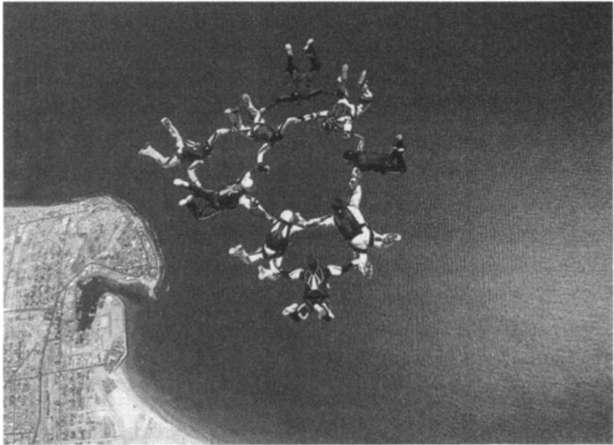
FIGURE 2.1 Sky diving: An innate fear of heights or a pleasurable experience? (Rocky Point Pictures; courtesy of Terry Schumacher.)
level is pre-consciousness, pre-thought. This is where appearance matters and first impressions are formed. Visceral design is about the initial impact of a product, about its appearance, touch, and feel.
The behavioral level is about use, about experience with a product. But experience itself has many facets: function, performance, and usability. A product's function specifies what activities it supports, what it is meant to do-if the functions are inadequate or of no interest, the product is of little value. Performance is about how well the product does those desired functions-if the performance is inadequate, the product fails. Usability describes the ease with which the user of the product can understand how it works and how to get it to perform. Confuse or frustrate the person who is using the product and negative emotions result. But if the product does what is needed, if it is fun to use and easy to satisfy goals with it, then the result is warm, positive affect.
It is only at the reflective level that consciousness and the highest
levels of feeling, emotions, and cognition reside. It is only here that the full impact of both thought and emotions are experienced. At the lower visceral and behavioral levels, there is only affect, but without interpretation or consciousness. Interpretation, understanding, and reasoning come from the reflective level.
Of the three levels, the reflective one is the most vulnerable to variability through culture, experience, education, and individual differences. This level can also override the others. Hence, one person's liking for otherwise distasteful or frightening visceral experiences that might repel others, or another's intellectual dismissal of designs others find attractive and appealing. Sophistication often brings with it a peculiar disdain for popular appeal, where the very aspects of a design that make it appeal to many people distress some intellectuals.
There is one other distinction among the levels: time. The visceral and behavioral levels are about "now," your feelings and experiences while actually seeing or using the product. But the reflective level extends much longer-through reflection you remember the past and contemplate the future. Reflective design, therefore, is about longterm relations, about the feelings of satisfaction produced by owning, displaying, and using a product. A person's self-identity is located within the reflective level, and here is where the interaction between the product and your identity is important as demonstrated in pride (or shame) of ownership or use. Customer interaction and service matter at this level.
Working with the Three Levels
The ways in which the three levels interact are complex. Still, for purposes of application, it is possible to make some very useful simplifications. So, although the scientist in me protests that what I am about to say is far too simple, the practical, engineering, designer side of me says that the simplification is good enough, and, more important, useful.
The three levels can be mapped to product characteristics like this:
- Visceral design
-
Appearance
- Behavioral design >
- The pleasure and effectiveness of use
- Reflective design >
- Self-image, personal satisfaction, memories
Even these simplifications are difficult to apply. Should some products be primarily visceral in appeal, others behavioral, others reflective? How does one trade off the requirements at one level against those of the others? How do visceral pleasures translate into products? Won't the same things that excite one group of people dismay others? Similarly, for the reflective level, wouldn't a deep reflective component be attractive to some and bore or repel others? And, yes, we can all agree that behavioral design is important-nobody is ever against usability-but just how much in the total scheme of things? How does each of the three levels compare in importance with the others?
The answer is, of course, that no single product can hope to satisfy everyone. The designer must know the audience for whom the product is intended. Although I have described the three levels separately, any real experience involves all three: a single level is rare in practice, and if it exists at all is most likely to come from the reflective level than from the behavioral or the visceral.
Consider the visceral level of design. On the one hand, this would appear to be the easiest level to appeal to since its responses are biological and similar for everyone across the world. This does not necessarily translate directly into preferences. Furthermore, although all people have roughly the same body shape, the same number of limbs, and the same mental apparatus, in detail, they differ considerably. People are athletic or not, energetic or lazy. Personality theorists divide people along such dimensions as extraversion, agreeableness, conscientiousness, emotional stability, and openness. To designers, this means that no single design will satisfy everyone.
In addition, there are large individual differences in the degree of a visceral response. Thus, while some people love sweets and especially chocolate (some claim to be addicts or "chocoholics"), many can ignore them, even if they like them. Almost everyone initially dislikes bitter and sour tastes, but you can learn affection for them, and they are often the components of the most expensive meals. Many foods loved by adults were intensely disliked at first taste: coffee, tea, alcoholic drinks, hot pepper, and even foods-oysters, octopus, and eyeballs-that make many people squeamish. And although the visceral system has evolved to protect the body against danger, many of our most popular and sought-after experiences involve horror and danger: horror novels and movies, death-defying rides, and thrilling, risky sports. And, as I have already mentioned, the pleasure of risk andperceived danger varies greatly among people. Such individual differences are the basic components of personality, the distinctions among people that make each of us unique.
Go outside. Get some air.
Watch a sunset.
Boy, does that get old fast.
- XBOX advertisement
(Microsoft's video game player)
THE TEXT of Microsoft's ad campaign for XBOX appeals to teens and young adults (whatever their actual age)who seek fast, exciting games with high visceral arousal, contrasting these people with those who prefer the commonly accepted norm that sunsets and fresh air are emotionally satisfying. The advertisement pits the reflective emotions of being outside and sitting quietly, enjoying the sunset against the continuous visceral and behavioral thrill of the fast-moving, engaging video game. Some people can spend hours watching sunsets. Some get bored after the first few seconds: "Been there, done that," is the refrain.
With the large range of individual, cultural, and physical differ-
ences among the people of the world, it is impossible for a single product to satisfy everyone. Some products are indeed marketed to everyone across the world, but they can succeed only if there are no real alternatives or if they do manage to reposition their appeal to different people through the adroit use of marketing and advertising. Hence, Coca-Cola and Pepsi-Cola manage worldwide success, in part capitalizing on a universal liking for sweet beverages, in part through sophisticated, culture-specific advertising. Personal computers are successful throughout the world because their benefits overcome their (numerous) deficiencies, and because there really is no choice. But most products have to be sensitive to the differences among people.
The only way to satisfy a wide variety of needs and preferences is to have a wide variety of products. Many product categories specialize, each catering to a different audience. Magazines are a good example. The world has tens of thousands of magazines (almost 20,000 in the United States alone). It is the rare magazine that tries to cater to everyone. Some magazines even flaunt their specialness, pointing out that they aren't for everyone, just for the people who match a particular set of interests and style.
Most product categories-home appliances, shop or gardening tools, furniture, stationery goods, automobiles-are manufactured and distributed differently across the world, with a wide variety of styles and form depending upon the needs and preferences of the market segment for whom they are targeted. Market segmentation is the marketing phrase used for this approach. Automobile companies bring out a variety of models, and different companies often emphasize different market segments. Some are for older, more sedate established people, some for the young and adventurous. Some are for those who truly need to go into the wilderness and travel through rivers and forests, up and down steep inclines, through mud,sand, and snow. Others are for those who like the reflective image of appearing to do such adventurous activities, but who will never actually do them.
Another important dimension for a product is its appropriateness to setting. In some sense, this point applies to all of human behavior:
What is appropriate and indeed preferred in one setting may be most inappropriate and rejected in another. All of us have learned to modulate our language, speaking differently when in casual interaction with our friends than when in formal presentation at a serious business meeting, or with the parents of our friends, or with our professors. Clothes that are appropriate for late-night clubs are inappropriate in business. A product that is cute and snuggly, or that conveys a humorous, playful image, is probably not appropriate for the business setting. Similarly, an industrial-style design, appropriate for the factory floor, would not be for the home kitchen or living room.
Computers sold to the home marketplace often are more powerful and have better sound systems than computers used in business. In fact, many business computers do not have some of the standard features of home machines, such as dial-out modems, sound systems, or DVD players. The reason is that these aspects of the machine are necessary for entertainment or game playing, activities not appropriate in the serious world of business. If a computer looks too attractive and playful, management may reject it. Some people feel that this hurt the sales of Apple's Macintosh computer. The Macintosh is considered a home, education, or graphics machine, not appropriate for business workers. This is an image problem because in fact, computers are pretty much the same, whether made by Apple or some other manufacturer, whether running the Macintosh or the Windows operating system, but images and psychological perceptions determine what people will buy.
The distinction between the terms needs and wants is a traditional way of describing the difference between what is truly necessary for a person's activities (needs) versus what a person asks for (wants). Needs are determined by the task: A pail is needed to carry water; some sort of carrying case is needed to transport papers back and forth to work. Wants are determined by culture, by advertising, by the way one views oneself and one's self-image. Although a student's backpack or even a paper bag would work perfectly fine for carrying papers, it might be embarrassing to carry one into a serious "power"
business meeting. Embarrassment is, of course, an emotion that reflects one's sense of the appropriateness of behavior and is really all in the mind. Product designers and marketing executives know that wants can often be more powerful than needs in determining the success of a product.
Satisfying people's true needs, including the requirements of different cultures, age groups, social and national requirements, is difficult. Now add the necessity to cater to the many wants-whims, opinions, and biases-of the people who actually purchase products, and the task becomes a major challenge. Note that many people purchase products for others, whether it be the purchasing department of a company trying to minimize cost, a parent buying for a child, or a contractor equipping a home with appliances that might enhance the sale of a house, whether or not the occupants would ever use them. To some designers, the challenge seems overwhelming. To others, it inspires.
One example of the challenge comes from the marketing of consoles for playing video games. Video game machines are clearly aimed squarely at the traditional game market: young males who love excitement and violence, who want rich graphics and sound and have quick reflexes, whether for sports or first-person shooting matches. The design of the machine reflects this image, as does the advertising: big, hefty, powerful, technical; young, virile, male. For this market, the game machines have been so wildly successful that the sales of video games exceeds the box-office sales of movies.
But although the design of these machines still seems to be targeted at young males, the actual market for video games is much broader. The average age is now around thirty, roughly as many women as men play, and the appeal is worldwide. In the United States, roughly half the population plays some sort of video game. Many of these games are no longer wild and violent. I discuss video games as a new genre of entertainment and literature in chapter 4, but here I want to focus on the fact that, despite the broader audience, the physical design of the game consoles has not been changed to meet the growing popularity. The design focus upon young, excitable males limits
the potential sales to a fraction of the possible audience, excluding not only many girls and women but also many men. This rich potential is completely untapped.
Moreover, the potential uses of video games extends far beyond the playing of games. They could be excellent teaching devices. In playing a game, you have to learn an amazing variety of skills and knowledge. You attend deeply and seriously for hours, weeks, even months. You read books and study the game thoroughly, doing active problem solving and working with other people. These are precisely the activities of an effective learner, so what marvelous learning could be experienced if only we could use this same intensity when interacting with meaningful topics. Thus, game machines have huge potential for everyone, but it has not been systematically addressed.
To break out of the traditional video game market, the industry needs to project a different kind of appeal. Here is where the three levels of design come into play. At the visceral level, the physical appearances of the consoles and controllers need to be changed. Different markets should have different designs. Some designs should reflect a warmer, more feminine approach. Some should look more serious, more professional. Some should have a more reflective appeal, especially for the educational marketplace. These changes wouldn't make the product dull and unexciting. They could make it as inviting and attractive as before, but emphasize different aspects of its potential. Its appearance should match its usage and audience.
Today, the behavioral design of many games revolves around powerful graphics and fast reflexes. Skill at operating the controls is one of the features distinguishing the beginning from the advanced player. To branch out into other arenas requires changing the behavioral characteristics so that they emphasize rich, detailed graphics and informative structures. In many domains, the emphasis should be on content, not on the skill of using the device, so ease of use should be stressed. Where content matters, the user should not have to spend time mastering the device, but rather should be able to devote time
and effort toward mastering the content, enjoying the presentations, and exploring the domain.
The reflective design of today's games projects a product image that is consistent with the sleek powerful appearance of the console and the fast reflexes required of the player. This has to be changed. Advertisements should promote the device as a learning and educational tool for people of all ages. One form of console should continue to project the image of powerful game machine. Others should be positioned to be an intelligent guide to activities such as cooking or auto mechanics or woodworking. And others should be positioned as an aid to learning. Each with different appearances, different modes of operation, and different advertising and marketing messages.
Now imagine the outcome. The device that used to be specialized for the playing of video games takes on different appearances, depending upon its intended function. In the garage, the device would look like shop machinery, with a serious, rugged appearance, impervious to damage. It would serve as tutor and assistant, displaying automobile manuals, mechanical drawings, and short videos of the required steps to maintain or upgrade the auto. In the kitchen, it matches the decor of kitchen appliances and becomes a cooking aid and tutor. In the living room, it fits with the furniture and books and becomes a reference manual, perhaps an encyclopedia, tutor, and player of reflective games (such as go, chess, cards, word games). And for the student, it is a source of simulations, experiments, and extensive exploration of interesting, well-motivated topics, but topics carefully chosen so that, in the process of enjoying the adventure, you automatically learn the fundamentals of your field. Designs appropriate to the audience, the location, and the purpose. Everything I have described here is doable. It simply hasn't yet been done.
Objects That Evoke Memories
True, long-lasting emotional feelings take time to develop: they come from sustained interaction. What do people love and cherish, despise and detest? Surface appearance and behavioral utility play relatively minor roles. Instead, what matters is the history of interaction, the associations that people have with the objects, and the memories they evoke.
Consider keepsakes and mementoes, postcards and souvenir monuments, such as the model of the Eiffel Tower shown in figure 2.2. These are seldom considered beautiful, seldom thought of as works of art. In the world of art and design they are called kitsch. This term of derision for the cheap and vulgar has been applied, says the Columbia Electronic Encyclopedia, "since the early 20th century to works considered pretentious and tasteless. Exploitative commercial objects such as Mona Lisa scarves and abominable plaster reproductions of sculptural masterpieces are described as kitsch, as are works that claim artistic value but are weak, cheap, or sentimental." "Sentimental" means, according to the American Heritage Dictionary, "resulting from or colored by emotion rather than reason or realism." "Emotion rather than reason"-well, yes, that is precisely the point.
Yogi Berra put it this way: "Nobody goes there anymore. It's too crowded." Or, translating this to design, "Nobody likes kitsch, it's too popular." Yup. If too many people like something, there must be something wrong with it. But isn't that very popularity telling us something? We should stop to consider just why it is popular. People find value in it. It satisfies some basic need. Those who deride kitsch are looking at the wrong aspects.
Yes, the cheap reproductions of famous paintings, buildings, and monuments are "cheap." They have little artistic merit, being copies of existing work, and poor copies at that. There is little intellectual depth, for the creativity and insight is part of the original, not the copy. Similarly, most souvenirs and popular trinkets are gaudy,
schmaltzy, "excessively or insincerely emotional." But while this may be true of the object itself, that object is important only as a symbol, as a source of memory, of associations. The word souvenir means "a token of remembrance, a memento." The very sentimentality the world of art or design derides is the source of something's strength and popularity. Kitschy objects of the sort shown in figure 2.2 do not pretend to be art-they are aids to memory.
In the world of design, we tend to associate emotion with beauty. We build attractive things, cute things, colorful things. However important these attributes, they are not what drive people in their everyday lives. We like attractive things because of the way they make us feel. And in the realm of feel-
FIGURE 2.2 A souvenir monument.
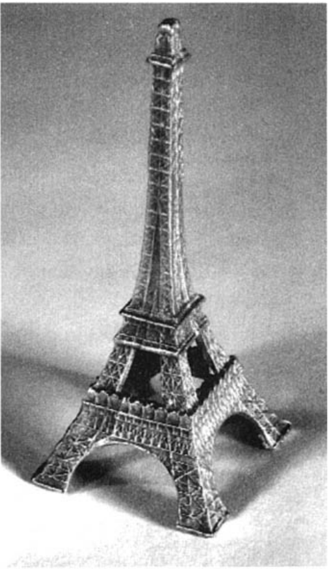
Although often denounced as "kitsch," unworthy of being considered as art, souvenirs are rich in emotional meanings because of the memories they evoke. (Author's collection.)
ings, it is just as reasonable to become attached to and love things that are ugly as it is to dislike things that would be called attractive. Emotions reflect our personal experiences, associations, and memories.
In The Meaning of Things, a book that should be required reading for designers, Mihaly Csikszentmihalyi and Eugene Rochberg-Halton study what makes things special. The authors went into homes and interviewed the residents, trying to understand their relationship to the things about them, to their material possessions. In particular, they asked each person to show things that were "special" to him or her,
and then, in the extensive interviews, explored what factors made them so. Special objects turned out to be those with special memories or associations, those that helped evoke a special feeling in their owners. Special items all evoked stories. Seldom was the focus upon the item itself: what mattered was the story, an occasion recalled. Thus, one woman interviewed by Csikszentmihalyi and Rochberg-Halton pointed to her living-room chairs and said: "They are the first two chairs me and my husband ever bought, and we sit in them and I just associate them with my home and having babies and sitting in the chairs with babies."
We become attached to things if they have a significant personal association, if they bring to mind pleasant, comforting moments. Perhaps more significant, however, is our attachment to places: favorite corners of our homes, favorite locations, favorite views. Our attachment is really not to the thing, it is to the relationship, to the meanings and feelings the thing represents. Csikszentmihalyi and Rochberg-Halton identify "psychic energy" as the key. Psychic energy, by which we mean mental energy, mental attention. Csikszentmihalyi's concept of "flow" provides a good example. In the flow state, you become so engrossed and captured by the activity being performed that it is as if you and the activity were one:You are in a trance where the world disappears from consciousness. Time stops. You are only aware of the activity itself. Flow is a motivating, captivating, addictive state. It can arise from transactions with valued things. "Household objects," say Csikszentmihalyi and Rochberg-Halton, "facilitate flow experiences in two different ways. On the one hand, by providing a familiar symbolic context they reaffirm the identity of the owner. On the other hand, objects in the household might provide opportunities for flow directly, by engaging the attention of people."
Perhaps the objects that are the most intimate and direct are those that we construct ourselves, hence the popularity of home-made crafts, furniture, and art. Similarly, personal photographs, even though they may be technically inferior: blurred, heads cut off, or fingers obscuring the image. Some may have faded, or be torn and
repaired with tape. Their surface appearance is less important than their ability to evoke the memory of particular people and events.
This point was vividly dramatized for me in 2002 when I walked through the exhibits on display at the San Francisco Airport. This is one of the world's most interesting museums-especially for people like me who are fascinated by everyday things, by the impact of technology upon people and society. This exhibition, "Miniature Monuments," was about the role of souvenirs in evoking memory. The show displayed hundreds of miniature monuments, buildings, and other souvenirs. The items were not on display for their artistic quality, but to applaud their sentimental value, for the memories they evoked and, in brief, for their emotional impact upon their owners. The text that accompanied the exhibition described the role of souvenir monuments thusly:
The marvel of souvenir buildings is that the identical miniature sparks in each of us extravagantly different webs of remembrance.
While the purpose of all monuments is to cause us to remember, their subjects have a wide range. Great people and important events; wars and their casualties; and the history of Astoria, Oregon, are memorialized in the monuments represented in miniature.
These souvenirs serve two purposes, though. Even as a copperplated pot metal replica of Lincoln's Tomb in Springfield, Illinois, causes us to remember the sixteenth president, it also prods recollection of the monument itself. Monuments may remember significant people and events; architectural miniatures remember the monuments.
The architect Bruce Goff has remarked, "In architecture, there's the reason you do something, and then there's the real reason." With souvenir buildings, despite their ostensible (if purposeless) functions, their real reason remains the provocation of human memory.
Those of us viewing these miniatures did not necessarily have any emotional attachment to the objects-after all, they weren't ours; they were collected and displayed by someone else. Still, as I strolled
around, I was most attracted to souvenirs of places I had myself visited, perhaps because they brought back memories of those visits. Had any one been emotionally negative, however, I would have quickly moved past it to escape-not the object but the memories it called forth in me.
PHOTOGRAPHS, MORE than almost anything else, have aspecial emotional appeal: they are personal, they tell stories. The power of personal photography lies in its ability to transport the viewer back in time to some socially relevant event. Personal photographs are mementos, reminders, and social instruments, allowing memories to be shared across time, place, and people. In the year 2000, there were about 200 million cameras in the United States alone, or around two cameras per household; with these cameras people took around 20 billion photographs. With the advent of digital cameras, it is no longer possible to know just how many pictures are being taken, but probably a lot more.
Although pictures are loved for the memories they maintain, the technologies of digital picture transmission, printing, file sharing, and display are sufficiently complex and time-consuming as to prevent many people from saving, retrieving, and sharing the pictures they cherish.
Numerous studies have shown that the work required to transform a picture in the camera into a print that can be shared defeats many people. Thus, while lots of pictures are taken, not all the film gets developed. Of the film that is developed, some of it is never looked at. Of the pictures that are looked at, many are simply put back into the envelope and then filed away in a box,never to be looked at again. (People in the photography industry call these "shoe boxes," because the storage is often within the cardboard boxes in which shoes come.) Some people carefully arrange their pictures in photo albums, but many of us have unused photo albums stored in closets or bookcases.
One of the most precious resources of the modern household is time, and the effort to take care of all those wonderful photographs
defeats their value. Even though taking photographs out of an envelope and organizing them in photograph albums is about as simple a way of doing this job as can be imagined, most people don't do it. I don't.
Digital cameras change the emphasis, but not the principle. It is relatively easy to take digital photographs, easy to share them from the display on the camera itself. It is more difficult to print the pictures or email them to friends and acquaintances. Despite the power of the personal computer, paper prints of photographs are easier to take care of and display than are electronic versions. With electronic pictures comes the problem of storing them in some way that you can find them again later.
Thus, although we like to look at photographs, we do not like to take the time to do the work required to maintain them and keep them accessible. The design challenge is to keep the virtues while removing the barriers: make it easier to store, send, share. Make it easier to find just the desired pictures years after they have been taken and put into storage. These are not easy problems, but until they are overcome, we will not reap the full benefits of photography.
Portraits of family, though, are different. Wander through many places of work, and you'll see on desk, bookcase, and walls framed photographs of a person's family: husband, wife, son, daughterfamily portraits, family snapshots-and occasionally parents. Yes, there are also ceremonial pictures of the person with the company president or other dignitaries, pictures of awards, and, in academic offices, conference photographs, where all the participants have gathered together sometime during the conference for the ritual photograph, which ends up published in the conference proceedings and posted on walls.
But, I hasten to add, this personal display is very culture-sensitive. Not all cultures display such personal symbols. In some countries, the display of personal photographs in the office is extremely rare, and in the home it can be infrequent. Instead, visitors are shown the photograph album, with each photograph lovingly pointed at and described. Some cultures prohibit photographs altogether. Still, the major
nations of the world on all continents take billions of photographs, so that even if they are not on public display, they serve a powerful emotional role.
Photographs are clearly important to people's emotional lives. People have been known to rush back into burning homes to save treasured photographs. Their comforting presence maintains family bonds even when the people are separated. They assure permanence of the memories and are often passed from generation to generation. In the days before photography, people hired portrait painters to create images of loved or respected ones. The task required long sittings and produced more formal results. Painting had the virtue that the artist could change people's appearance to fit their desires rather than be restricted to the reality of the photograph. (Nowadays, with digital tools readily available, photographs, too, are easily doctored. I plead guilty to altering a family group photograph, replacing the scowling face of one family member with a happy, smiling face from a photograph of that person at a different occasion. Nobody has ever noticed the modification, not even the person who was modified.) Today, even with the ubiquity of personal cameras, portrait photographers maintain a lively business, in part because only professionals usually have the skills required for lighting and framing the shot so as to produce a high-quality picture.
Photographs can bring back only sights, not sounds. David Frohlich, a research scientist at the Hewlett Packard Laboratories in Bristol, England, has been developing a system he calls "audiophotography," photographs that combine an audio track, capturing the sounds on the scene surrounding the instant when the picture was taken. (Yes, the recording can start before the photograph is taken, one of the magical possibilities of modern technology.) Amy Cowen, who wrote about Frohlich's work, described its importance this way: "With every photo there is a story, a moment, a memory. As time passes, however, the user's ability to recall the details needed to evoke the moment the picture records fades. Adding sound to a photo can help keep the memories intact."
Frohlich points out that today's technology allows us both to capture the sounds occurring around the time a photograph is being taken and also to play them back while it is being shown in an album. The sounds capture the emotional setting in a far richer way than can the image itself. Imagine a family group photograph where, in the twenty seconds prior to the taking of the picture, the voices of family members joshing among themselves ("Mary, stop scowling" and "Henry, quick, stand between Frank and Uncle Oscar") are also recordedpossibly followed by giggling and relief in the twenty seconds after the photo was taken. Frohlich describes the possibilities this way: "Ambient sounds recorded around the moment of image capture provide an atmosphere or mood that can really help you remember the original event better. Nostalgic music set to a photo can evoke more feelings and memories of the era in which the photo was taken, and a spoken story can help others to interpret the meaning of the photo, especially in the absence of the photographer."
Feelings of Self
Memories reflect our life experiences. They remind us of families and friends, of experiences and accomplishments. They also serve to reinforce how we view ourselves. Our self-image plays a more important role in our lives than we like to admit. Even those who deny any interest in how others view them actually do care, if only by making sure that everyone else understands that they don't. The way we dress and behave, the material objects we possess, jewelry and watches, cars and homes, all are public expressions of our selves.
The concept of self appears to be a fundamental human attribute. It is difficult to imagine how it could be otherwise, given what we know of the mechanisms of mind and the roles that consciousness and emotion play. The concept is deeply rooted in the reflective level of the brain and highly dependent upon cultural norms. It is, therefore, difficult to deal with in design.
In psychology, the study of the self has become a big industry, with books, societies, journals, and conferences. But "self" is a complex concept: It is culturally specific. Thus, Eastern and Western notions of self vary considerably, with the West placing more emphasis on the individual, the East on the group. Americans tend to want to excel as individuals, whereas Japanese wish to be good members of their groups and for others to be satisfied with their contributions. But even these characterizations are too broad and oversimplified. In fact, on the whole, people behave very similarly, given the same situation. It is culture that presents us with different situations. Thus, Asian cultures are more likely to establish a sharing, group attitude than are the cultures of Europe and the Americas, where individualistic situations are more common. But put Asians in an individualistic situation and Europeans or Americans in a social, sharing situation, and their behaviors are remarkably similar.
Some aspects of self seem to be universal, such as the desire to be well-thought-of by others, even if the behavior others praise differs across cultures. This desire holds both in the most individualistic societies, which admire deviance, and in the most group-oriented societies, which admire conformance.
The importance of other people's opinions is, of course, well known to the advertising industry, which tries to promote products through association. Take any product and show it alongside happy, contented people. Show people doing things that an intended purchaser is likely to fantasize about, such as romantic vacations, skiing, exotic locations, eating in foreign lands. Show famous people, people who serve as role models or heroes to the customers, to induce in them, through association, a sense of worthiness. Products can be designed to enhance these aspects. In clothing fashion, one can have clothes that are neat and trim or baggy and nondescript, each deliberately inducing a different image of self. When company or brand logos are imprinted on clothes, luggage, or other objects, the mere appearance of the name speaks to others about your sense of values. The styles of objects you choose to buy and display often reflect public opinion as
much as behavioral or visceral elements. Your choice of products, or where and how you live, travel, and behave are often powerful statements of self, whether intended or not, conscious or subconscious. For some, this external manifestation compensates for an internal, personal lack of self-esteem. Whether you admit it or not, approve or disapprove, the products you buy and your lifestyle both reflect and establish your self-image, as well as the images others have of you.
One of the more powerful ways to induce a positive sense of self is through a personal sense of accomplishment. This is one aspect of a hobby, where people can create things that are uniquely theirs, and, through hobby clubs and groups, share their achievements.
From the late 1940s through the mid-1980s the Heathkit Company sold electronic kits for the home handyperson. Build your own radio, your own audio system, your own television set. The people who constructed the kits felt immense pride in their accomplishments as well as a common bond with other kit builders. Putting together a kit was a personal feat: the less skilled the kit builder, the more that special feeling. Electronic experts did not take such pride in their kits; it was those who ventured forth without the expertise who felt so satisfied. Heathkit did an excellent job of aiding the first-time builder with what, in my opinion, were the best instruction manuals ever written. Mind you,the kits were not much less expensive than equivalent commercial electronic devices. People bought the kits for their high quality and for the feeling of accomplishment, not to save money.
In the early 1950s, the Betty Crocker Company introduced a cake mix so that people could readily make excellent tasting cakes at home. No muss, no fuss: just add water, mix, and bake. The product failed, even though taste tests confirmed that people liked the result. Why? An after-the-fact effort was made to find the reasons. As the market researchers Bonnie Goebert and Herma Rosenthal put it: "The cake mix was a little too simple. The consumer felt no sense of accomplishment, no involvement with the product. It made her feel useless, especially if somewhere her aproned mom was still whipping up cakes from scratch."
Yes, it was too easy to make the cake. Betty Crocker solved the problem by requiring the cook to add an egg to the mix, thereby putting pride back into the activity. Clearly, adding an egg to a prepared cake mix is not at all equivalent to baking a cake "from scratch" by using individual ingredients. Nonetheless, adding the egg gave the act of baking a sense of accomplishment, whereas just mixing water into the cake mix seemed too little, too artificial. Goebert and Rosenthal summarized the situation: "The real problem had nothing to do with the product's intrinsic value, but instead represented the emotional connection that links a product to its user." Yes, it's all about emotion, about pride, about the feeling of accomplishment, even in making a cake from a prepared mix.
The Personality of Products
As we have seen, a product can have a personality. So, too, can companies and brands. Consider my proposed transformation of the video game device discussed earlier in this chapter. In one version, the machine would be a fast, powerful tool for exciting, visceral experiences: loud booming sounds and fast-paced adventure. In a different version, it would be a cooking assistant: animated, but informative,with menus for meals and videos that demonstrate just how to prepare the food. In still another, it might be calm, but authoritative, guiding repair work on an automobile or construction of woodworking projects.
In each manifestation, that product's personality would change. The product would look and behave differently in the different settings appropriate to use and target audience. The style of behavioral interaction could differ: filled with slang and informal language in the game setting; polite and formal for the kitchen. But like human personality, once established, all aspects of a design must support the intended personality structure. A mature cooking tutor should not suddenly start spouting obscenities. A shop assistant should probably not discuss the philosophical implications of quality in automobile
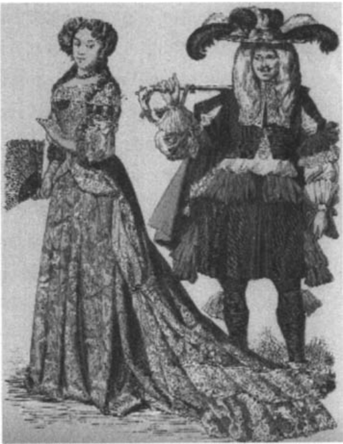
Northwestern University Library.)
design, quoting from R. M. Pirsig's Zen and the Art of Motorcycle Maintenance whenever a repair is attempted.
Figure 2.3 Fashion from the seventeenth century. On the left, Maria Anna of Bavaria, crown princess of France. On the right, a "young elegant." (Braun et al., courtesy of
Personality is, of course, a complex topic in its own right. A simplified way of thinking of product personality is that it reflects the many decisions about how a product looks, behaves, and is positioned throughout its marketing and advertisements. Thus, all three levels of design play a role. Personality must be matched to market segment. And it must be consistent. Think about it. If a person or product has an obnoxious personality, at least you know what to expect: you can plan for it. When behavior is inconsistent and erratic, it is difficult to know what to expect, and occasional positive surprises are not enough to overcome the frustration and irritation caused by never quite knowing what to expect.
The personalities of products, companies, and brands need as much tending to as the product itself.
The American Heritage Dictionary defines fashion, style, mode, and vogue thus: "These nouns refer to a prevailing or preferred manner of dress, adornment, behavior, or way of life at a given time. Fashion, the broadest term, usually refers to what accords with conventions adopted by polite society or by any culture or subculture: a time when long hair was the fashion. Style is sometimes used interchangeably
with fashion, but like mode often stresses adherence to standards of elegance: traveling in style; miniskirts that were the mode in the late sixties. Vogue is applied to fashion that prevails widely and often suggests enthusiastic but short-lived acceptance: a video game that was in vogue a few years ago."
The very existence of the terms fashion, style, mode, and vogue demonstrates the fragility of the reflective side of design. What is liked today may not be tomorrow. Indeed, the reason for the change is the very fact that something was once liked: When too many people like something, then it is no longer deemed appropriate for the leaders of a society to partake of it. After all,goes the thinking, how can one be a leader unless one is different, doing today what others will do tomorrow, and doing tomorrow what they will be doing after that? Even the rebellious have to change continually, carefully noticing what is in fashion so as not to be following it, carefully creating their own fashion of counterfashion.
How does a designer cope with popular taste if it has little to do with substance? Well, it depends upon the nature of the product and the intentions of the company producing it. If the product is something fundamental to life and well-being, then the proper response is to ignore continual shifts in popular sentiment and aim for long-lasting value. Yes, the product must be attractive. Yes, it should be pleasurable and fun. But it must also be effective, understandable, and appropriately priced. In other words, it must strive for balance among the three levels of design.
In the long run,simple style with quality construction and effective performance still wins. So a business that manufactures office machines, or basic home appliances, or web sites for shipping, commerce, or information, would be wise to stick to the fundamentals. In these cases, the task dictates the design: make the design fit the task, and the product works more smoothly and is bound to be more effective across a wide range of users and uses. Here is where the number of different products is determined by the nature of particular tasks and the economics.
There is a set of products, however, whose goals are entertainment, or style, or perhaps enhancement of a person's image. Here is where fashion comes into play. Here is where the huge individual differences in people and cultures are important. Here the person and marketsegment dictate the design. Make the design appropriate to the market segment that forms the target audience. It is probably necessary to have multiple versions of the design for different market segments. And it is probably necessary to do rapid changes in style and appearance as the market dictates.
Designing for the whims of fashion is tricky. Some designers may see it as a difficult challenge, others, as an opportunity. In some sense, the division often breaks between large and small companies, or between market leaders and the competition. To the market leader, the continual changes in people's fashion, and the wide variety of preferences for the same product across the world, are huge challenges. How can the company ever keep up? How does it track all the changes and even anticipate them? How does it keep the many necessary product lines effective? To the competitive companies, however, the same issues represent an opportunity. Small companies can be nimble, moving rapidly into areas and using approaches that the more conservative larger companies hesitate to try. Small companies can be outrageous, different, and experimental. They can exploit the public's interests, even if the product is initially purchased by only a few. Large companies attempt to experiment by spinning off smaller, more nimble divisions, sometimes with unique names that make them appear to be independent of their parent. All in all,this is the ever-changing, continual battleground of the consumer marketplace, where fashion can be as important as substance.
IN THE world of products, a brand is an identifying mark, the symbol that represents a company and its products. Particular brands produce an emotional response that draws the consumer toward the product or away from it. Brands have taken on the emotional repre-
sentation. They carry with them an emotional response that guides us toward a product or away from it. Sergio Zyman, former chief marketing officer of Coca-Cola, has said that "emotional branding is about building relationships; it is about giving a brand and a product long-term value." But it is more: it involves the entire relationship of the product to the individual. Again, in Zyman's words: "Emotional branding is based on that unique trust that is established with an audience. It elevates purchases based on need to the realm of desire. The commitment to a product or an institution, the pride we feel upon receiving a wonderful gift of a brand we love or having a positive shopping experience in an inspiring environment where someone knows our name or brings an unexpected gift of coffee-these feelings are at the core of Emotional Branding."
Some brands are simply informative, essentially naming a company or its product. But on the whole, the brand name is a symbol thatrepresents one's entire experience with a product and the company that produces it. Some brands represent quality and high prices. Some represent a focus upon service. Some represent value for money. And some brands stand for shoddy products, for indifferent service, or for inconvenience at best. And, of course, most brand names are meaningless, carrying no emotional power at all.
Brands are all about emotions. And emotions are all about judgment. Brands are signifiers of our emotional responses, which is why they are so important in the world of commerce.
THIS CONCLUDES part I of the book: the basic tools of emotional design. Attractive things do work better-their attractiveness produces positive emotions, causing mental processes to be more creative, more tolerant of minor difficulties. The three levels of processing lead to three corresponding forms of design: visceral, behavioral, and reflective. Each plays a critical role in human behavior, each an equally critical role in the design, marketing, and use of products. Now it is time to explore how this knowledge is put to work.
Design in Practice
FIGURE 3.1
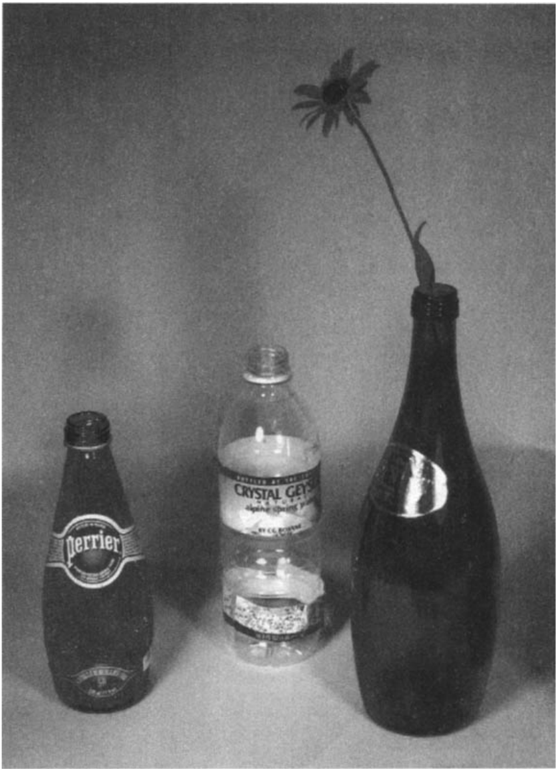
Water bottles. The ones on the left and the right are clearly aimed to please at the visceral level; the middle one, well, it is efficient, it is inexpensive, and it works. The bottle on the left, for Perrier water, has become so well known that the shape and its green color are the brand. The bottle on the right is by TyNant, a bottle of such a pleasant shape coupled with its deep, cobalt blue color that people save the empty ones to use as vases. The clear plastic bottle is by Crystal Geyser: simple, utilitarian, effective when you need to carry water with you.
(Author's collection.)