Attractive Things Work Better
NOAM TRACTINSKY, AN ISRAELI SCIENTIST, WAS puzzled. Attractive things certainly should be preferred over ugly ones, but why would they work better? Yet in the early 1990s, two Japanese researchers, Masaaki Kurosu and Kaori Kashimura, claimed just that. They studied different layouts of controls for ATMs, automated teller machines that allow us to perform simple banking tasks any time of the day or night. All versions of the ATMs were identical in function, the number of buttons, and how they operated, but some had the buttons and screens arranged attractively, the others unattractively. Surprise! The Japanese found that the attractive ones were perceived to be easier to use.
Tractinsky was suspicious. Maybe the experiment had flaws. Or perhaps the result could be true of Japanese, but certainly not of Israelis. "Clearly," said Tractinsky, "aesthetic preferences are culturally dependent." Moreover, he continued, "Japanese culture is
known for its aesthetic tradition," but Israelis? Nah,Israelis are action-oriented-they don't care about beauty. So Tractinsky redid the experiment. He got the ATM layouts from Kurosu and Kashimura, translated them from Japanese into Hebrew, and designed a new experiment, with rigorous methodological controls. Not only did he replicate the Japanese findings, but-contrary to his belief that usability and aesthetics "were not expected to correlate"-the results were stronger in Israel than in Japan. Tractinsky was so surprised that he put that phrase "were not expected" in italics, an unusual thing to do in a scientific paper, but appropriate, he felt, given the unexpected conclusion.
In the early 1900s, Herbert Read, who wrote numerous books on art and aesthetics, stated, "it requires a somewhat mystical theory of aesthetics to find any necessary connection between beauty and function," and that belief is still common today. How could aesthetics affect how easy something is to use? I had just started a research project examining the interaction of affect, behavior, and cognition, but Tractinsky's results bothered me-I couldn't explain them. Still, they were intriguing, and they supported my own personal experiences, some of which I described in the prologue. As I pondered the experimental results, I realized they fit with the new framework that my research collaborators and I were constructing as well as with new findings in the study of affect and emotion. Emotions, we now know, change the way the human mind solves problems-the emotional system changes how the cognitive system operates. So, if aesthetics would change our emotional state, that would explain the mystery. Let me explain.
Until recently, emotion was an ill-explored part of human psychology. Some people thought it an evolutionary leftover from our animal origins. Most thought of emotions as a problem to be overcome by rational, logical thinking. And most of the research focused upon negative emotions such as stress, fear, anxiety, and anger. Modern work has completely reversed this view. Science now knows thatevolutionarily more advanced animals are more emotional than primitive
ones, the human being the most emotional of all. Moreover, emotions play a critical role in daily lives, helping assess situations as good or bad, safe or dangerous. As I discussed in the prologue, emotions aid in decision making. Positive emotions are as important as negative ones-positive emotions are critical to learning, curiosity, and creative thought, and today research is turning toward this dimension. One finding particularly intrigued me: The psychologist Alice Isen and her colleagues have shown that being happy broadens the thought processes and facilitates creative thinking. Isen discovered that when people were asked to solve difficult problems, ones that required unusual "out of the box" thinking, they did much better when they had just been given a small gift-not much of a gift, but enough to make them feel good. When you feel good, Isen discovered, you are better at brainstorming, at examining multiple alternatives. And it doesn't take much to make people feel good. All Isen had to do was ask people to watch a few minutes of a comedy film or receive a small bag of candy.
We have long known that when people are anxious they tend to narrow their thought processes, concentrating upon aspects directly relevant to a problem. This is a useful strategy in escaping from danger, but not in thinking of imaginative new approaches to a problem. Isen's results show that when people are relaxed and happy, their thought processes expand, becoming more creative, more imaginative.
These and related findings suggest the role of aesthetics in product design: attractive things make people feel good, which in turn makes them think more creatively. How does that make something easier to use? Simple, by making it easier for people to find solutions to the problems they encounter. With most products, if the first thing you try fails to produce the desired result, the most natural response is to try again, only with more effort. In today's world of computercontrolled products, doing the same operation over again is very unlikely to yield better results. The correct response is to look for alternative solutions. The tendency to repeat the same operation over again is especially likely for those who are anxious or tense. This state
of negative affect leads people to focus upon the problematic details, and if this strategy fails to provide a solution, they get even more tense, more anxious, and increase their concentration upon those troublesome details. Contrast this behavior with those who are in a positive emotional state, but encountering the same problem. These people are apt to look around for alternative approaches, which is very likely to lead to a satisfying end. Afterward, the tense andanxious people will complain about the difficulties whereas the relaxed, happy ones will probably not even remember them. In other words, happy people are more effective in finding alternative solutions and, as a result, are tolerant of minor difficulties. Herbert Read thought we would need a mystical theory to connect beauty and function. Well, it took one hundred years, but today we have that theory, one based in biology, neuroscience, and psychology, not mysticism.
Human beings have evolved over millions of years to function effectively in the rich and complex environment of the world. Our perceptual systems, our limbs, the motor system-which means the control of all our muscles-everything has evolved to make us function better in the world. Affect, emotion, and cognition have also evolved to interact with and complement one another. Cognition interprets the world, leading to increased understanding and knowledge. Affect, which includes emotion, is a system of judging what's good or bad, safe or dangerous. It makes value judgments, the better to survive.
The affective system also controls the muscles of the body and, through chemical neurotransmitters, changes how the brain functions. The muscle actions get us ready to respond, but they also serve assignals to others we encounter, which provides yet another powerful role of emotion as communication: our body posture and facial expression give others clues to our emotional state. Cognition and affect, understanding and evaluation-together they form a powerful team.
Three Levels of Processing: Visceral, Behavioral, and Reflective
Human beings are, of course, the most complex of all animals, with accordingly complex brain structures. A lot of preferences are present at birth, part of the body's basic protective mechanisms. But we also have powerful brain mechanisms for accomplishing things, for creating, and for acting. We can be skilled artists, musicians, athletes, writers, or carpenters. All this requires a much more complex brain structure than is involved in automatic responses to the world. And finally, unique among animals, we have language and art, humor and music. We are conscious of our role in the world and we can reflect upon past experiences, the better to learn; toward the future, the better to be prepared; and inwardly, the better to deal with current activities.
My studies of emotion, conducted with my colleagues Andrew Ortony and William Revelle, professors in the Psychology Department at Northwestern University, suggest that these human attributes result from three different levels of the brain: the automatic, prewired layer, called the visceral level', the part that contains the brain processes that control everyday behavior, known as the behavioral level; and the contemplative part of the brain, or the reflective level. Each level plays a different role in the total functioning of people. And, as I discuss in detail in chapter 3, each level requires a different style of design.
The three levels in part reflect the biological origins of the brain, starting with primitive one-celled organisms and slowly evolving to more complex animals, to the vertebrates, the mammals, and finally, apes and humans. For simple animals, life is a continuing set of threats and opportunities, and an animal must learn how to respond appropriately to each. The basic brain circuits, then, are really response mechanisms: analyze a situation and respond. This system is tightly coupled to the animal's muscles. If something is bad or dangerous, the muscles tense in preparation for running, attacking, or freezing. If something
FIGURE 1.1
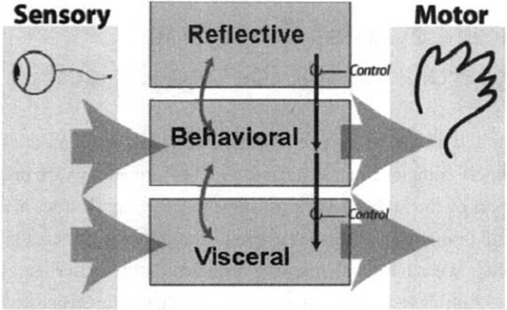
Three levels of processing: Visceral, Behavioral, and Reflective.
The visceral level is fast: it makes rapid judgments of what is good or bad, safe or dangerous, and sends appropriate signals to the muscles (the motor system) and alerts the rest of the brain. This is the start of affective processing. These are biologically determined and can be inhibited or enhanced through control signals from above. The behavioral level is the site of most human behavior. Its actions can be enhanced or inhibited by the reflective layer and, in turn, it can enhance or inhibit the visceral layer. The highest layer is that of reflective thought. Note that it does not have direct access either to sensory input or to the control of behavior. Instead it watches over, reflects upon, and tries to bias the behavioral level.
(Modified from a figure by Daniel Russell for Norman, Ortony, & Russell, 2003.)
is good or desirable, the animal can relax and take advantage of the situation. As evolution continued, the circuits for analyzing and responding improved and became more sophisticated. Put a section of wire mesh fence between an animal and some desirable food: a chicken is likely to be stuck forever, straining at the fence, but unable to get to the food; a dog simply runs around it. Human beings have an even more developed set of brain structures. They can reflect upon their experiences and communicate them to others. Thus, not only do we walk around fences to get to our goals, but we can then think back about the experience-reflect upon it-and decide to move the fence or the food, so we don't have to walk around the next time. We can
also tell other people about the problem, so they will know what to do even before they get there.
Animals such as lizards operate primarily at the visceral level. This is the level of fixed routines, where the brain analyzes the world and responds. Dogs and other mammals, however, have a higher level of analysis, the behavioral level, with a complex and powerful brain that can analyze a situation and alter behavior accordingly. The behavioral level in human beings is especially valuable for well-learned, routine operations. This is where the skilled performer excels.
At the highest evolutionary level of development, the human brain can think about its own operations. This is the home of reflection, of conscious thought, of the learning of new concepts and generalizations about the world.
The behavioral level is not conscious, which is why you can successfully drive your automobile subconsciously at the behavioral level while consciously thinking of something else at the reflective level. Skilled performers make use of this facility. Thus, skilled piano players can let their fingers play automatically while they reflect upon the higher-order structure of the music. This is why they can hold conversations while playing and why performers sometimes lose their place in the music and have to listen to themselves play to find out where they are. That is, the reflective level was lost, but the behavioral level did just fine.
Now let's look at some examples of these three levels in action: riding a roller coaster; chopping and dicing food with a sharp, balanced knife and a solid cutting board; and contemplating a serious work of literature or art. These three activities impact us in different ways. The first is the most primitive, the visceral reaction to falling, excessive speed, and heights. The second, the pleasure of using a good tool effectively, refers to the feelings accompanying skilled accomplishment, and derives from the behavioral level. This is the pleasure any expert feels when doing something well, such as driving a difficult course or playing a complex piece of music. This behavioral pleasure, in turn, is different from that provided by serious literature or art,
FIGURE 1.2 People pay money to get scared.
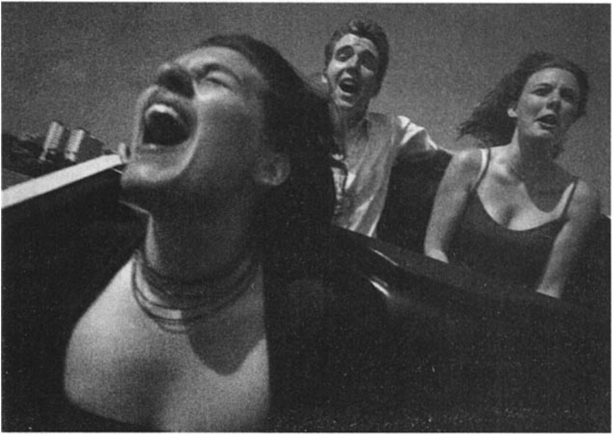
The roller coaster pits one level of affect-the visceral sense of fearagainst another level-the reflective pride of accomplishment.
(Photograph by Bill Vane, © 2007 Corbis, all rights reserved.)
whose enjoyment derives from the reflective level, and requires study and interpretation.
Most interesting of all is when one level plays off of another, as in the roller coaster. If the roller coaster is so frightening, why is it so popular? There are at least two reasons. First, some people seem to love fear itself: they enjoy the high arousal and increased adrenaline rush that accompanies danger. The second reason comes from the feelings that follow the ride: the pride in conquering fear and of being able to brag about it to others. In both cases, the visceral angst competes with the reflective pleasure-not always successfully, for many people refuse to go on those rides or, having done it once, refuse to do it again. But this adds to the pleasure of those who do go on the ride: their self image is enhanced because they have dared do an action that others reject.
Focus and Creativity
The three levels interact with one another, each modulating the others. When activity is initiated from the lowest, visceral levels, it is called "bottom-up." When the activity comes from the highest, reflective level, it is called "top-down" behavior. These terms come from the standard way of showing the processing structures of the brain, with the bottom layers associated with interpreting sensory inputs to the body and the top layers associated with higher thought processes, much as I illustrated in Figure 1.1. Bottom-up processes are those driven by perception whereas top-down are driven by thought. The brain changes its manner of operation when bathed in the liquid chemicals called neurotransmitters. A neurotransmitter does what its name implies: It changes how neurons transmit neural impulses from one nerve cell to another (that is, across synapses). Some neurotransmitters enhance transmission, some inhibit it. See, hear, feel, or otherwise sense the environment, and the affective system passesjudgment, alerting other centers in the brain, and releasing neurotransmitters appropriate to the affective state. That's bottom-up activation. Think something at the reflective level and the thoughts are transmitted to the lower levels which, in turn, triggers neurotransmitters.
The result is that everything you do has both a cognitive and an affective component-cognitive to assign meaning, affective to assign value. You cannot escape affect: it is always there. More important, the affective state, whether positive or negative affect, changes how we think.
When you are in a state of negative affect, feeling anxious or endangered, the neurotransmitters focus the brain processing. Focus refers to the ability to concentrate upon a topic, without distraction, and then to go deeper and deeper into the topic until some resolution is reached. Focus also implies concentration upon the details. It is very important for survival, which is where negative affect plays a major role. Whenever your brain detects something that might be danger-
ous, whether through visceral or reflective processing, your affective system acts to tense muscles in preparation for action and to alert the behavioral and reflective levels to stop and concentrate upon the problem. The neurotransmitters bias the brain to focus upon the problem and avoid distractions. This is just what you need to do in order to deal with danger.
When you are in a state of positive affect, the very opposite actions take place. Now, neurotransmitters broaden the brain processing, the muscles can relax, and the brain attends to the opportunities offered by the positive affect. The broadening means that you are now far less focused, and far more likely to be receptive to interruptions and to attending to any novel idea or event. Positive affect arouses curiosity, engages creativity, and makes the brain into an effective learning organism. With positive affect, you are more likely to see the forest than the trees, to prefer the big picture and not to concentrate upon details. On the other hand, when you are sad or anxious, feeling negative affect, you are more likely to see the trees before the forest, the details before the big picture.
What role do these states have in design? First, someone who is relaxed, happy, in a pleasant mood, is more creative, more able to overlook and cope with minor problems with a device-especially if it's fun to work with. Recall the reviewer of the Mini Cooper automobile, quoted in the prologue, who recommended that the car's faults be ignored because it was so much fun. Second, when people are anxious, they are more focused, so where this is likely to be the case, the designer must pay special attention to ensure that all the information required to do the task is continually at hand, readily visible, with clear and unambiguous feedback about the operations that the device is performing. Designers can get away with more if the product is fun and enjoyable. Things intended to be used under stressful situations require a lot more care, with much more attention to detail.
One interesting effect of the differences in thought processes of the two states is the impact upon the design process itself. Design-and for that matter, most problem solving-requires creative thinking fol-
lowed by a considerable period of concentrated, focused effort. In the first case, creativity, it is good for the designer to be relaxed, in a good mood. Thus, in brainstorming sessions, it is common to warm up by telling jokes and playing games. No criticism is allowed because it would raise the level of anxiety among the participants. Good brainstorming and unusual, creative thinking require the relaxed state induced by positive affect.
Once the creative stage is completed, the ideas that have been generated have to be transformed into real products. Now the design team must exert considerable attention to detail. Here, focus is essential. One way to do this is through deadlines just slightly shorter than feel comfortable. Here is the time for the concentrated focus that negative affect produces. This is one reason people often impose deadlines on themselves, and then announce those deadlines to others so as to make them real. Their anxiety helps them get the work done.
It is tricky to design things that must accommodate both creative thinking and focus. Suppose the design task is to build a control room for operators of a plant-think of a nuclear power plant or a large chemical-processing plant, but the same lessons apply to many manufacturing and production facilities. The design is meant to enhance some critical procedure or function-say to enable control room operators to watch over a plant and solve problems as they arise-so it is probably best to have a neutral or a slightly negative affect to keep people aroused and focused. This calls for an attractive, pleasant environment so that in normal monitoring, the operators are creative and open to explore new situations. Once some plant parameter approaches a dangerous level, however, the design should change its stance, yielding a negative affect that will keep the operators focused upon the task at hand.
How do you design something so that it can change from invoking a positive affect to invoking a negative one? There are several ways. One is through the use of sound. The visual appearance of the plant can be positive and enjoyable. During normal operation, it is even possible to play light background music, unless the control room is located where the sounds of the plant operating can be used to indi-
cate its state. But as soon as any problem exists, the music should go away and alarms should start to sound. Buzzing, ringing alarms are negative and anxiety producing, so their presence alone might do the trick. Indeed, the problem is not to overdo it: too much anxiety produces a phenomenon known as "tunnel vision," where the people become so focused they may fail to see otherwise obvious alternatives.
The dangers of too much focus are well known to people who study accidents. Thus, special design and training is required of people if we want them to perform well under high stress. Basically, because of the extreme focus and tunnel vision induced by high anxiety, the situation has to be designed to minimize the need for creative thought. That's why professionals are trained over and over again in accident scenarios, through training exercises and simulators, so that if a real incident occurs, they will have experienced it so many times in training that their responses follow automatically. But this training works only if the training is repeated frequently and performance is tested. In commercial aviation, the pilots and crew are well trained, but the passengers are not. Even though frequent fliers continually hear and see the instructions on how to escape the airplane in case of fire or crash, they sit passively, only partially attentive. They are not apt to remember them in an emergency.
"Fire," yells someone in a theater. Immediately everyone stampedes toward the exits. What do they do at the exit door? Push. If the door doesn't open, they push harder. But what if the door opens inward and must be pulled, not pushed? Highly anxious, highly focused people are very unlikely to think of pulling.
When under high anxiety-high negative affect-people focus upon escape. When they reach the door, they push. And when this fails, the natural response is to push even harder. Countless people have died as a result. Now, fire laws require what is called "panic hardware." The doors of auditoriums have to open outward, and they must open whenever pressure is applied.
Similarly, designers of exit stairways have to block any direct path from the ground floor to those floors below it. Otherwise, people
using a stairway to escape a fire are likely to miss the ground floor and continue all the way into the basement-and some buildings have several levels of basements-to end up trapped.
The Prepared Brain
Although the visceral level is the simplest and most primitive part of the brain, it is sensitive to a very wide range of conditions. These are genetically determined, with the conditions evolving slowly over the time course of evolution. They all share one property, however: the condition can be recognized simply by the sensory information. The visceral level is incapable of reasoning, of comparing a situation with past history. It works by what cognitive scientists call "pattern matching." What are people genetically programmed for? Those situations and objects that, throughout evolutionary history, offer food, warmth, or protection give rise to positive affect. These conditions include:
warm, comfortably lit places, temperate climate, sweet tastes and smells, bright, highly saturated hues, "soothing" sounds and simple melodies and rhythms, harmonious music and sounds, caresses, smiling faces, rhythmic beats, "attractive" people, symmetrical objects,
rounded, smooth objects,
"sensuous" feelings, sounds, and shapes.
Similarly, here are some of the conditions that appear to produce automatic negative affect:
heights,
sudden, unexpected loud sounds or bright lights,
"looming" objects (objects that appear to be about to hit the
observer),
extreme hot or cold,
darkness,
extremely bright lights or loud sounds,
empty, flat terrain (deserts),
crowded dense terrain (jungles or forests),
crowds of people,
rotting smells, decaying foods
bitter tastes,
sharp objects,
harsh, abrupt sounds,
grating and discordant sounds,
misshapen human bodies,
snakes and spiders,
human feces (and its smell),
other people's body fluids,
vomit.
These lists are my best guess about what might be automatically programmed into the human system. Some of the items are still under dispute; others will probably have to be added. Some are politically incorrect in that they appear to produce value judgments on dimensions society has deemed to be irrelevant. The advantage human beings have over other animals is our powerful reflective level that enables us to overcome the dictates of the visceral, pure biological level. We can overcome our biological heritage.
Note that some biological mechanisms are only predispositions rather than full-fledged systems. Thus, although we are predisposed to be afraid of snakes and spiders, the actual fear is not present in all people: it needs to be triggered through experience. Although human language comes from the behavioral and reflective levels, it provides a
good example of how biological predispositions mix with experience. The human brain comes ready for language: the architecture of the brain, the way the different components are structured and interact, constrains the very nature of language. Children do not come into the world with language, but they do come predisposed and ready. That is the biological part. But the particular language you learn, and the accent with which you speak it, are determined through experience. Because the brain is prepared to learn language, everyone does so unless they have severe neurological or physical deficits. Moreover, the learning is automatic: we may have to go to school to learn to read and write, but not to listen and speak. Spoken language-or signing, for those who are deaf-is natural. Although languages differ, they all follow certain universal regularities. But once the first language has been learned, it highly influences later language acquisition. If you have ever tried to learn a second language beyond your teenage years, you know how different it is from learning the first, how much harder, how reflective and conscious it seems compared to the subconscious, relatively effortless experience of learning the first language. Accents are the hardest thing to learn for the older language-learner, so that people who learn a language later in life may be completely fluent in their speech, understanding, and writing, but maintain the accent of their first language.
Tinko and losse are two words in the mythical language Elvish, invented by the British philologist J. R. R. Tolkien for his trilogy, The Lord of the Rings. Which of the words "tinko " and "losse " means "metal," which "snow"? How could you possibly know? The surprise is that when forced to guess, most people can get the choices right, even if they have never read the books, never experienced the words. Tinko has two hard, "plosive" sounds-the "t" and the "k." Losse has soft, liquid sounds, starting with the "1" and continuing through the vowels and the sibilant "ss." Note the similar pattern in the English words where the hard "t" in "metal" contrasts with the soft sounds of "snow." Yes, in Elvish, tinko is metal and losse is snow.
The Elvish demonstration points out the relationship between the
sounds of a language and the meaning of words. At first glance, this sounds nonsensical-after all, words are arbitrary. But more and more evidence piles up linking sounds to particular general meanings. For instance, vowels are warm and soft: feminine is the term frequently used. Harsh sounds are, well, harsh-just like the word "harsh" itself and the "sh" sound in particular. Snakes hiss and slither; and note the sibilants, the hissing of the "s" sounds. Plosives, sounds caused when the air is stopped briefly, then released-explosively-are hard, metallic; the word "masculine" is often applied to them. The "k" of "mosquito" and the "p" in "happy" are plosive. And, yes, there is evidence that word choices are not arbitrary: a sound symbolism governs the development of a language. This is another instance where artists, poets in this case, have long known the power of sounds to evoke affect and emotions within the readers of-or, more accurately, listeners to-poetry.
All these prewired mechanisms are vital to daily life and our interactions with people and things. Accordingly, they are important for design. While designers can use this knowledge of the brain to make designs more effective, there is no simple set of rules. The human mind is incredibly complex, and although all people have basically the same form of body and brain, they also have huge individual differences.
Emotions, moods, traits, and personality are all aspects of the different ways in which people's minds work, especially along the affective, emotional domain. Emotions change behavior over a relatively short term, for they are responsive to the immediate events. Emotions last for relatively short periods-minutes or hours. Moods are longer lasting, measured perhaps in hours or days. Traits are very long-lasting, years or even a lifetime. And personality is the particular collection of traits of a person that last a lifetime. But all of these are changeable as well. We all have multiple personalities, emphasizingsome traits when with families, a different set when with friends. We all change our operating parameters to be appropriate for the situation we are in.
Ever watch a movie with great enjoyment, then watch it a second time and wonder what on earth you saw in it the first time? The same phenomenon occurs in almost all aspects of life, whether in interactions with people, in a sport, a book, or even a walk in the woods. This phenomenon can bedevil the designer who wants to know how to design something that will appeal to everyone: One person's acceptance is another one's rejection. Worse, what is appealing at one moment may not be at another.
The source of this complexity can be found in the three levels of processing. At the visceral level, people are pretty much the same all over the world. Yes, individuals vary, so although almost everyone is born with a fear of heights, this fear is so extreme in some people that they cannot function normally-they have acrophobia. Yet others have only mild fear, and they can overcome it sufficiently to do rock climbing, circus acts, or other jobs that have them working high in the air.
The behavioral and reflective levels, however, are very sensitive to experiences, training, and education. Cultural views have huge impact here: what one culture finds appealing, another may not. Indeed, teenage culture seems to dislike things solely because adult culture likes them.
So what is the designer to do? In part, that is the theme of the rest of the book. But the challenges should be thought of as opportunities. Designers will never lack for things to do, for new approaches to explore.
TWO