build the house you want to live in
You can dream, create, design and build the most wonderful place in the world . . . but it requires people to make the dream a reality.
WALT DISNEY
Whenever I have to decide what to do next, I ask myself the question Gary Keller poses in The One Thing : 'What's the one thing you can do such that by doing it everything else will be easier or unnecessary?'
That's why in this book we've focused on community before process, process before product, sales before marketing, and marketing before growth.
When it comes to the people in your company, the answer to Keller's question is to focus on culture before hiring. Before you're ready to hire anyone, you first need to make a company people want to work for. That begins with setting your values, preferably as early as possible, because values are the foundation of the culture you will build together with your employees.
I used to think that communicating company values was kind of dumb, to be honest. Be nice, work hard, show up on time-isn't it obvious? Then I started Gumroad and realized that if you don't constantly remind everyone -including yourself-what you do, how you do it, and why you do it that way, you will veer off course. And then you'll have to make corrections, usually at the most inopportune time.
For me this happened in the fall of 2014, when I first started having conversations with VCs about the next round of funding for Gumroad. When I realized that it wasn't going to be easy, if at all possible, to raise our Series B round of funding, I had to realign several team members around a very different kind of culture-one focused on building a profitable, sustainable business rather than a unicorn. We didn't shift our prioritieswe were and still are creators first-but our new focus required me to have conversations around the career trajectory some of our employees expected. And let me tell you, it's a lot more difficult, emotional, and expensive to fix your culture than your code.
Humans are not computers. We are all unpredictable, emotional creatures. Each person you hire makes the matrix of interactions within your organization more complex. You will make mistakes, but your company values will give you a plan of attack for how to get back on track.
Today, forty-eight people work on Gumroad, based all over the world, and they seem quite happy! But I had my fair share of ups and downs to get here. In this chapter, I'll share everything I've learned the hard way about hiring the right people at the right pace and keeping them happy and productive in the face of a never-ending barrage of lucrative and glamorous offers for their talent, particularly in the technology space. I also address the challenges and opportunities of remote work and other unconventional approaches to solving problems with people. It's an ongoing process that never really stops.
Before you invite anyone over, you need to get your house in order. I've never seen a house party end cleaner than when it started, and a company is a house party that never ends. So let's get started figuring out what kind of house you want to live in and then filling it with the awesome people who are going to come along with you on this journey.
Define Your Values Early and Often
Values are not generic two-word commandments that companies use to state the obvious. Quite the opposite: They're for stating the non-obvious, in non-obvious ways. They codify what you believe, putting it in a place where everyone can see-and everyone can suggest changes.
Values are oral tradition. They tell employees a story of how to behave in both everyday and extreme situations. And they're more efficient mediums of information than manuals and handbooks. That's because good values stick in the brain; they're efficient and memorable.
Nordstrom, for example, is famed for its customer service. In one iconic story, a customer brings a set of tires to the store to return even though Nordstrom sells clothes, not tires. The store accepts the tires anyway and fully refunds the customer. In another tale, a clerk who can't find the right pair of shoes at any nearby Nordstrom store recommends a competitor, Macy's, and covers shipping for the customer.
These stories communicate more about the kind of service Nordstromand its customers- expect than a thousand-page manual on 'how to be a good sales clerk' ever could. You could start working there tomorrow and already have a good sense of what kind of standards you would need to uphold to be a good 'fit.'
That's because values aren't just for the people within the company. They tell your customers and the people who may consider working for you that you exist, and that they might be a great match. More important, they tell everyone else that your company isn't right for them, saving you, and them, precious time.
That absolute clarity is particularly important for minimalist entrepreneurs because we often attract people for whom this may be a first job. Defining and communicating your company's values early sets expectations for how work is done and how disagreements are handled within the organization. They're not just a vehicle for you to push your will on your team. They help hold your team together and provide a way for your team to hold you accountable.
Values supersede you, and values allow you to scale. After all, one of the reasons you started a business is to control your environment: when you work, how you work, where you work, who you work with, who you work for, and more. Values make sure that everyone is aligned on what that looks like. This is especially important when it comes to making difficult decisions.
Natalie Nagale, cofounder and CEO of Wildbit, knows this firsthand. She and her husband, Chris, founded Wildbit in 2000, and in 2012 the growth of Beanstalk, the workflow software that was one of their core products, plateaued.
'That was an important time for us,' she says, 'because we were forced to ask why we were building and what we wanted to grow.' One of Wildbit's principles is that businesses are product agnostic, which helped them make the decision to shift Beanstalk to maintenance and support mode. When they finally stopped trying 'to put out Beanstalk fires,' they were able to focus on intentionally growing Postmark, an email delivery service that was their other core product.
In the years since, not being defined by one project or product has given Wildbit more freedom to 'celebrate every opportunity to learn,' which is one of their core values. In practice, this means that if something, even a long-term project, stops being interesting or challenging, they move on. After five years, Wildbit shut down Conveyor, meant to be a successor to Beanstalk, in 2020; this might have been devastating for another company, but for Wildbit it made space for their team to launch two new projects, People First Jobs, a job board, and DMARC Digests, a monitoring service to prevent email scams.
Making decisions that affect the lives of your team and your customers is not something to be taken lightly. But if you've decided on your values and have developed a culture around them, it will be a lot easier. A lot of founders think they can wait to write down their values, that they'll appear to them just in time, and that culture will develop naturally. That's true, but be forewarned that it may not be a culture you want for you, your team, or your customers.
You can start small and grow from there. But it is important to start having these conversations-even if it's just with yourself. You can communicate your values through pithy statements, or you can draw them out into long stories, but you should start.
At Gumroad our values exist in a culture doc titled 'What Matters.' And to help you get started with your own, I've embedded them for your reference below. They may not be exactly the right values for your company, but I hope they're a good starting point for reflection and action.
At this point you are already familiar with Gumroad, the product. Introducing . . . Gumroad, the company!
JUDGED BY THE WORK
This value is about being real about what matters: the experience creatorsand their customers- have when they use Gumroad.
How I communicate this internally:
Our creators don't care about us. They care about the product, content, and community we happen to provide.
That means a few things:
- While we often work in silos, we do not ship alone. Everything we send to creators is of the highest quality, meaning that everything is reviewed by multiple people on the Gumroad team, our creators (they're first!), and other folks in our broader community. For example, I published my Work article (sahillavingia.com/work) after addressing 600 comments from 150 people. That is extreme, but it meant hundreds of thousands of people read something better.
- We are okay with employee churn (in fact, I encourage it if it helps us ship a superior product).
Lastly, it should be considered a failure to receive feedback on something that could have made a creator's life better after you shipped.
SEEK SUPERLINEARITIES
This value is a way to define and to encourage growth. Though superlinearity is a mathematical concept referring to a function that eventually grows faster than any linear one, at Gumroad it represents our willingness to learn at a constantly accelerating pace.
How I communicate this internally:
We have a fixed number of hours and an unlimited amount of creator income to actualize. Everything we do should contribute to our creators' bottom lines in a measurable and scalable way. Every day you are producing superlinear returns on your time investment.
What this means in practice is that job responsibilities at Gumroad change quickly. Employees might outgrow their roles and leave Gumroad to start their own companies. Great!
EVERYONE IS A CEO
This value is about building a company of like-minded people. I'm a CEO, and I think it's a pretty great job, so I want to create a company full of them.
How I communicate this internally:
Ultimately, you are responsible for spending our creators' money, and it's your job to tell the company how you're doing that.
You are the CEO of your function, and it is your responsibility to make sure it is executing at a high level and communicating proof to the rest of the company- and our creators.
You need to think strategically (about business and product), proactively get things done, ask for help when needed, and hold yourself accountable before I need to.
Similarly, don't waste resources:
- Everyone is doing something important when you ask them for help, so do what you can to save them time and expensive back-and-forth. This means providing all the context anyone needs, including objective measurements.
- Think like a CEO asking for approval from their board, not like an employee asking their manager for direction. If someone needs to ask you how things are going, they are not going well.
Most people don't want to be CEOs; most people don't want to work for a company that has these expectations for its workforce. That's fine too; the people who do want to become CEOs find our situation appealing, and they're the ones I believe will create the most value for our creators anyway.
DARE TO BE OPEN
Given you're reading our internal values, this is likely the clearest of the bunch.
How I communicate this internally:
If there's a Gumroad secret, it's this one: we aim for complete information symmetry. There's nothing I know that you don't, and eventually there'll be nothing you and I know that our creators don't.
We are building the best product, with the best team, for the best community. Being open about everything is the flywheel that brings more amazing people into our ecosystem.
This manifests in numerous ways, like making our on-boarding documents publicly available and sharing our financials on Twitter every month. That way, not only does everyone who works at Gumroad know what we're about, but our customers and anyone who might even think about working at Gumroad knows too.
I recommend this level of transparency to everyone. The upside is that some of the people who get to know more about your company will love you. The downside is that some won't. They won't agree with the way you do business. They'll disagree with your policies on product quality and remote work or pick apart your numbers. Having a point of view and putting it into practice can be polarizing, but if what you're doing works for you, your customers, and your employees, and the company is profitable, you can sleep at night knowing you're doing the right thing. No one can take it away from you.
Another plus is that when things aren't going well, transparency can lead to the kind of reflection that will make things better. The most profound thing I have learned running a company has been the difference between behavior and intention. Behavior is what someone is doing; intention is why they're doing it. Most people judge themselves based on their own intentions but then judge others based on their behavior. Transparency makes that difficult, if not impossible.
As the CEO of an impactful company, it's important for me to be open about my intentions. Then others can look at my behavior and suggest improvements so that they match up better. Sunlight may not always be the best disinfectant, but it often helps.
Transparency isn't just about what we show to the world; it's also about how we operate internally. In chapter 3, I talked about the processes we use to run our business, all of which are documented and available for every employee to see. Day-to-day, we use tools such as Slack and Notion to keep everyone in our company aware of what is happening and to give employees clarity about how their work matters. It's easy for people to peer into anything if they're curious (or take over if need be). The cumulative effect of the open environment we've created with public numbers, no meetings, and open communication is that there are no secrets and no FOMO.
For example, everyone at Gumroad can see via an online dashboard how much our creators are earning. It does run the risk of creating a counterproductive obsession with the numbers (sometimes it is the founder's job to worry about the bottom line, not the employees'), but generally I've found that empowering your team with the data they need to make their own decisions creates a better, more self-sufficient organization. Plus, it means you need to do less, which is a big reason you chose to be a minimalist entrepreneur in the first place.
We also give everyone access to the traffic dashboards, and several of our engineers, when they are looking to take a break from their normal workload, will go in there and see what pages of the site they can speed up. These are things I may never have prioritized, but they save our customers time and improve our product offering.
Ultimately, if you hire well, your employees will be better managers of themselves than you could ever be. And in the long run, giving everyone autonomy allows you to be a peer to your employees so that you can code alongside your engineers, design alongside your designers, and spend your time creating and building something impactful rather than constantly managing others. As long as you continue to lay out the long-term vision for the company based on clearly articulated values, your employees will be happy to support you.
Transparency also matters when it comes to the harder things like money. At Gumroad, we disclose everyone's salary in the company to everyone else, using a simple spreadsheet I keep up to date. This lets people feel good about how much they make and minimizes information asymmetry between me and the rest of the team. Revealing that kind of information may seem scary at first, but that's just because it's unusual. In practice it vastly reduces the number of questions people ask about their compensation, and it also helps combat wage disparity because of bias.
Laying out the numbers behind the business and the salaries you're paying people tells your employees how their work contributes to the overall profitability of the business. That information makes it easier for everyone when it comes time to have an honest conversation about how much they deserve to get paid. Global studies reveal that 79 percent of people who quit their jobs cite 'lack of appreciation' as their reason for leaving, and though it's normal, even expected, for employees to outgrow your company and move on, you don't want unnecessary turnover to be a part of the culture of your business.
Beware of the Peter Principle
I don't like to manage. I would much rather have ten amazing people on my team than a hundred good ones. That might mean that we cannot ship as much code as the next startup on an absolute basis, but on a per-person basis we are far more productive and more fulfilled because of it.
Ultimately, a company scales successfully because employees are empowered to help customers without your intervention. Your job, and the job of any management team you build, is to give them the resources to succeed, and, when necessary, the thirty-thousand-foot view so they can clearly see where their work fits into the big picture without having to undertake the stressful process of investigating on their own.
Don't be a product visionary-or, worse, a product dictator. Your company shouldn't be a cult of personality, building exclusively what you want on the timelines you decide. WeWork is one example of how that path leads to certain doom. Among the numerous excesses, questionable decision making, and lavish capital infusions based on little evidence that the company might ever be profitable, one fascinating detail stands out. Even though WeWork's business has nothing to do with surfing, the board approved a $13 million investment in a company that made artificial wave pools because former CEO Adam Neumann is an avid surfer.
That, of course, is an extreme case of the ways in which a CEO's ideas and preferences, however irrational and counter to the interests of the business, can sink the business itself, but the point still stands. Whether you have three employees or three hundred, have clear key performance indicators (KPI) that everyone knows about and can measure their work against, which will allow everyone to either talk to or build for customers.
The Peter Principle, coined by educator Laurence J. Peter, states that 'the tendency in most organization hierarchies, such as that of a corporation, is for every employee to rise in the hierarchy through promotion until they reach a level of respective incompetence.'
Though it was originally meant as satire, you may be able to relate to the idea that within a strict hierarchy, everyone gets stuck with the job they're not good at. At Gumroad, I've tried to turn the Peter Principle on its head. Employees work for customers. I work for my employees. The best people continue to do the jobs they're best at as they get promoted- they just get paid more to do it.
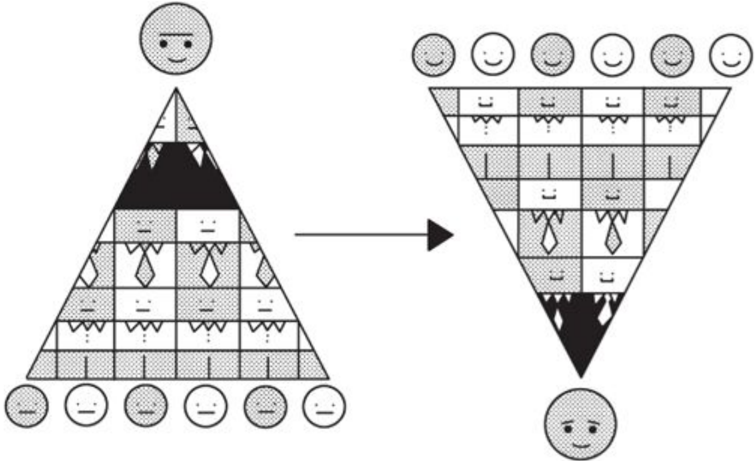
The problem with managers is that they aren't really invested in the success of the people they manage. But sometimes it's more than just being invested in your employees' success on the job; it's about caring about and investing in your employees' career aspirations and growth-beyond what your company might require. It's about the long-term game for everyone involved.
This might even mean encouraging your employees to leave to find more growth elsewhere, which we'll cover at the end of this chapter.
Create Accountability
Gumroad has been remote since 2015.
I think that remote work is going to be the norm for pretty much every business that doesn't need an office. Which is almost every business that pivoted and figured out a way to keep going with a distributed team during the COVID-19 pandemic.
When you don't have an office, you don't need to restrict yourself to the folks in your local geography. You can hire people across the worldfinding the best people and bringing them into your company without either of you ever leaving home or needing to fly halfway across the world.
Once you've taken that step, you might realize that other conventional wisdom about how to run a company doesn't make sense either. Meetings, for example. Most companies use meetings as an essential tool to get their work done, but we don't have meetings at Gumroad. We've even taken it a step further: we're fully asynchronous. This has meant that for us, all communication is thoughtful. Because nothing is urgent-unless the site is down-discussion takes place only after mindful processing.
But what happens when something urgent does happen? The truth is that our business model doesn't produce the kind of 'drop everything and deal with it now' situations that might occur if, for example, your company is reliant on business development and a key customer is pulling out because of a feature degradation or a missed deadline.
If something does require near-immediate engagement, we use Slack as our closest-to-real-time communication channel. GitHub is where we keep our codebase and where engineers submit their code for peer review before it is merged in and deployed live. Notion is for everything else. It is what we use to host our roadmap (which we make public) and our product development processes, as well as where we house our knowledge sharing around how each person does their job.
This three-pronged system is a useful heuristic to help employees know where to go to get help when they need it. In a few hours, Slack. In a day or two, GitHub. Longer than that, Notion. Transparency around metrics and team compensation is important-but it's also important to make it easy to surface the right information at the right time for the right people.
If something does need to be discussed in really-real time, we now use Clubhouse for audio-only conversations. As a bonus, we can pull our customers into meetings much more easily than if it were a Zoom call.
This culture requires everyone to tell everyone else when they plan to do 'deep work,' a term coined by writer Cal Newport indicating focused, cognitively demanding tasks. Much of the work we do, including writing, coding, and designing, doesn't lend itself well to interruptions. Beyond setting expectations, people can decide how they wish to implement this. They can let others know when they plan to surface and respond to questions, or they can turn off their notifications for weeks on end. For me, this is as simple as blocking out times in my calendar.
Clear expectations around availability allow people to build their work around their life, not the other way around. This is especially great for new parents, but everyone benefits from being able to structure their days to maximize their happiness and productivity, and most people can learn to manage themselves and be productive and impactful.
I recognize that what I do and what we do at Gumroad may not work for every founder or every company, depending on the nature of the business. While flexible work hours are becoming more common, some companies function best when they are totally asynchronous and remote like us, while others use a hybrid of remote work and shared time at coworking spaces. As long as you keep a laser focus on delivering the best product to your customers, creating a system that works will develop organically from the bottom up rather than feeling like something dictated from the top.
Ultimately, it's up to you to decide what kind of house you want to live in and then find people who agree. Gumroad's values are a little offbeat. You might even say they're a little scary. But they guide everything we do, and they communicate what the world needs to know about our company.
Our values may not work for most people. For them, Gumroad isn't a fit. Luckily, there are millions of other companies that are.
How Simply Eloped Defined Its Values and Got Back on Track
Hiring before defining your values and culture is a challenge many founders face, perhaps because it is the default, but luckily it's an issue you can come back from.
Janessa White and Matt Dalley are two founders who ran into trouble when they started hiring at Simply Eloped, a company that helps couples plan intimate or destination weddings. Up until then, Matt and Janessa had been doing everything right. They grew slowly and were strategic about every dollar they spent. Before they started hiring, they had performed every function-customer service, marketing, sales-themselves, and it had allowed them to develop their own systems and to be adaptable and creative, especially when it came to money.
They had also made conscious choices about the vendors they hired to represent Simply Eloped. 'The wedding industry can be full of discrimination, so from the very beginning, we built relationships with officiants, florists, bakers, and others who shared our values and felt comfortable with all sorts of couples. I had spent years talking with customers,' Janessa said, 'and I knew that we were offering the kind of affordable, inclusive service that people couldn't find anywhere else.'
Even though Matt and Janessa had been deliberate about the kinds of external relationships they wanted to cultivate, they hadn't been as intentional about the culture they wanted to build inside Simply Eloped. In 2019, they raised capital and began a hiring push. 'We made every mistake in the book,' they said. 'We hired for our wish list, we hired friends and family, and we hired anyone who seemed nice and wanted a job.' The result was what Janessa called a 'cultural crisis' during which bullying, gossip, and drama became common-place.
Their first step to correcting course was to hire a leadership coach who began the process of identifying what was happening and how to fix it. Matt and Janessa were forced to ask themselves what kind of leaders they needed to be to manage a growing team. They saw that they had focused too much on making their employees 'happy' and not enough time defining what would best serve their customers and provide the best work atmosphere.
They also realized that even though they and many of their customers loved the company, it wasn't going to be the right fit for everyone. This revelation sent them back to the drawing board to consider their values, which they now define using the acronym CACAO, for 'customer-centric, ambitious, compassionate, adaptable, and ownership.' What's more, they translated those values into a list of attributes that describe the type of person who will thrive at Simply Eloped, and they now draw from that list for their job postings.
In addition, Janessa, Matt, and their team explicitly use Simply Eloped's values to highlight success and to give feedback; during the weekly announcements, Janessa weaves in company values to tell stories about employees' small wins; on the flip side, if someone isn't performing well, she can use the values as context for how and why to improve. Values have ended up being so important at Simply Eloped that Matt and Janessa even wrote a song about them that every employee learns.
While you may not want or need to write a song about your company values (we definitely are never going to write a song at Gumroad), it's worth noting how clearly Janessa and Matt articulate and define the company's values, for themselves and for everyone who works there. They've found something that works for them, and their clear values enable them to grow knowing where they're going and who they want to bring along with them.
Tell the World Who You Are
Ultimately, it will be more work to build your company culture than your product. But it will also be more valuable. And at the end of it, you will have a company that fulfills your goals and the goals of many others as well.
People do not change jobs often, and they often don't declare to the world when they're thinking about doing so. In chapter 5, we talked about how marketing is about reminding prospective customers that you exist, over and over again. Similarly, hiring well is about reminding prospective candidates that you exist, and why you exist, over and over again.
And just like we learned in chapter 4, good sales isn't just about salesit's about education. Hiring is one of the hardest things about startups, because it's about product development, sales, and marketing-all at once!
Once you have cultural values that work for you, start to communicate them publicly. Many people fear that communicating these values will alienate people from looking further into their company. This is exactly correct. Clearly defining your cultural values allows most folks to say, 'This isn't for me,' and a select few to say, 'THIS IS EXACTLY THE JOB FOR ME!'
Great people will only apply if they see a job that matches (or exceeds) their expectations for what their ideal work life could be like. If you can, reflect on any painful or stressful job searches you've had, and how often you've gotten to the end of a long interview process with a company only to realize they weren't a fit for you at all.
Communicating your values saves everyone time and energy. You only want to interview the candidates who think they're a really good fit for you, not people who are just looking for their next job or a pay raise. Ultimately, the greatest candidates are the ones who plan to replace you.
Hiring Looks a Lot Like Firing Yourself
From the beginning, you should look to hire people who are better than you. They're not there to implement your vision but to improve upon it based on their own interactions with customers.
Some of them may even be your previous customers. At Gumroad, we make a point to hire from our community first.
Many founders fail to delegate well, but it begins with selfawareness. Ask yourself:
- What do I most enjoy doing?
- What am I good at, and what am I not so good at?
- What function would be a relief to pass to someone else?
- How do I spend most of my time, and is that the right choice?
Once you figure out exactly what job you are hiring for, you can figure out who may be a fit. But often you won't know. Again, this is why it's important to get good at shouting into the ether and letting people come to you.
Your job listings should be a filter, not a magnet. Most people won't enjoy working at your company, and your job listings should make it clear that they should look elsewhere. The people who get all the way through are the ones you should have more serious conversations with.
If you do this well, hiring becomes much easier and faster. And because of your minimalist approach to building your business, you already have communities, customers, and a marketing muscle with which to best engage them.
For example, a single tweet from my personal Twitter account led to hundreds of applicants:
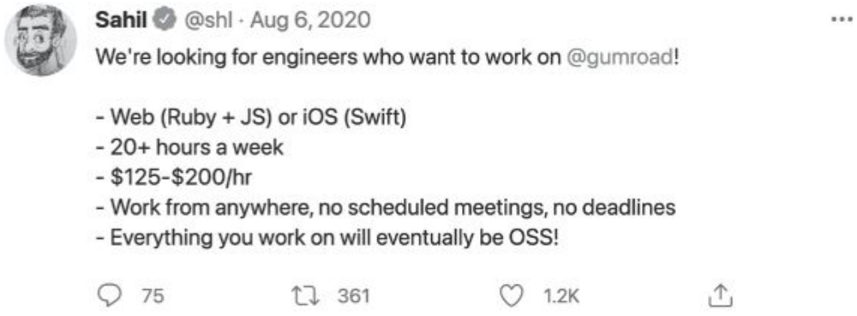
This isn't just true for me. Adam Wathan's single tweet about a job working on Tailwind UI led to 875 applicants. His tweet, similar to mine,
was clear and opinionated:

If you're interested in building Ul tools with me full-time; were looking for a developer to join the Tailwind CSS team
$115k-$135k/year; 4 weeks vacation; and 40 hours a week of hacking on fun, interesting problems

Revisit your values, and make sure they are embedded in your job post just like everything else that you write. For Gumroad that means making it clear how much we pay, what we expect of our people, and what we don't offer. But your values will be different from ours, and so your job posts will be too.
Fit Is Two-Way
Unfortunately, not everyone who joins your company will stick around for the long term, or maybe even the short term. Fit is two-way; when someone isn't working out for you, it also means you aren't working out for them. And someone who isn't a great fit for your company is hurting their own long-term prospects just like they are hurting yours.
When in doubt, reflect on your values. Does this person match? Would this person be creating more value outside of your company than within it? Would you hire them today if you knew then what you know now?
Truthfully, when you start doubting, you probably know the answer and just aren't comfortable making the hard decision of letting them go.
Believe me, I know how difficult it is to fire people. But it is an essential skill if you want to build the house you want to live in. To my people, I promise no surprises. Even if it's not a fit, I make it clear-and, due to our asynchronous culture, in writing-exactly why I have concerns that it may not be a fit, corresponding each issue with our values. I do this at least twice over several weeks, making sure they have the clarity and time to make the changes I need them to make.
But ultimately it's their choice, and often the best thing you can do is to have an honest conversation, tell them it's not working out, and wind things down. Almost every time, they'll be grateful you brought it up instead of them. And if you've been hiring well, they'll find a new job in no time at all. And you should help them with that, providing introductions and a positive reference-you did hire them, after all. They weren't bad employees, they just weren't a fit for you.
Your company is a business, not a cult. Embrace change, don't abhor it.
Speaking of change. . . . At this point you'll have a product that customers are happy paying for and a company that people are happy to work for. What comes next?
If you're having fun, you can keep doing what you're doing. Or you can do something completely new. That's what the next chapter is about. We'll talk about broadening and deepening your impact, as well as how to improve your own quality of life. On some level, that's what this whole book has been about: identifying and helping those you love- including yourself-in a way that aligns your own life with the lives of others. Let's go.
KEY TAKEAWAYS
- You've already built one product for customers, now you're building another: The product is your company, and your customers are your employees.
- Building a company full of humans is more rewarding than building software, but it is also much harder.
- Articulate your values early and often, because you will need them to avoid veering off course as you grow. (It'll happen anyway.)
Fit is two-way: If it's not working out for you, it's probably not working out for them.
- Have the hard conversations early, as they'll only get harder the longer you wait.
Learn More
- Read Reinventing Organizations , a book by Frédéric Laloux, for a mind-bending look into how the structures of companies and other organizations have changed over time.
- Follow Janessa White, co-CEO and cofounder of Simply Eloped, on Twitter (@janessanwhite) for insights from building her business.
- Read The Peter Principle, a book by Laurence J. Peter and Raymond Hull.